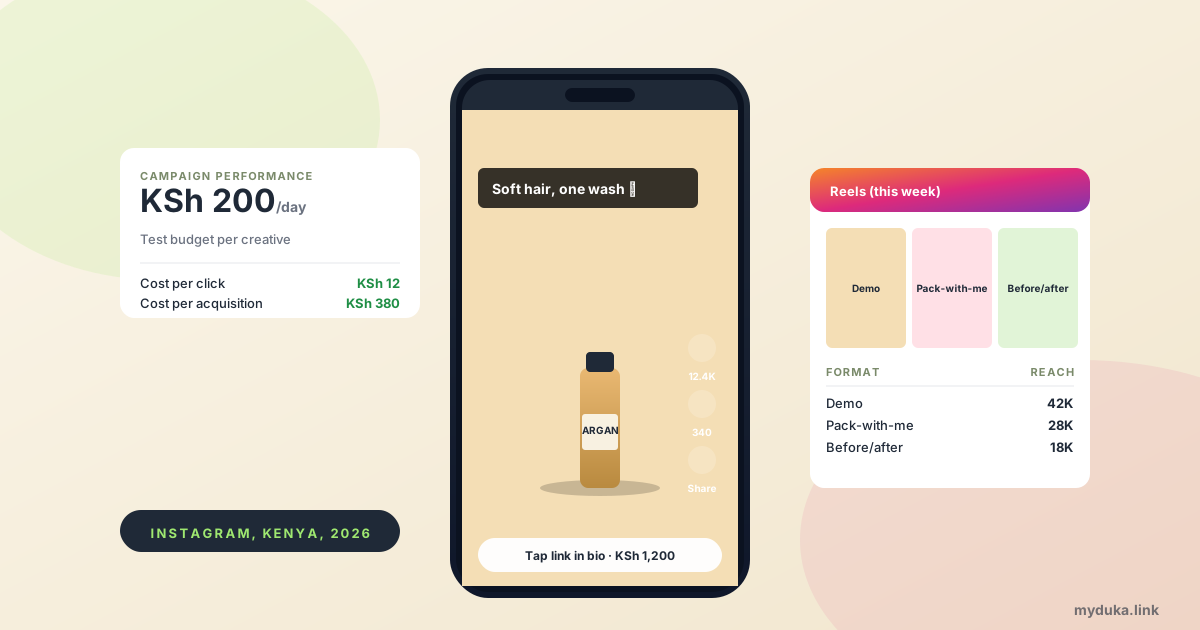
Instagram still moves more product for Kenyan small shops than any other paid channel — but only if you use it the way Instagram works in 2026, not the way it worked in 2021. Static feed posts are mostly invisible to non-followers. Stories last 24 hours and reach mostly people who already follow you. Reels are where the organic reach lives. Paid ads are how you accelerate what's working.
This guide walks through what to post, how often, what to spend, and how to know if any of it is working — for a Kenyan online shop in 2026. If you also need the bigger picture, our complete guide to starting an online business in Kenya covers payments, shipping, and registration.
The new rules of Instagram in 2026
The Instagram algorithm in 2026 favours one format above all others: vertical Reels, 9 to 30 seconds long, with audio. Carousels still work for in-feed depth. Static photos still serve a purpose for the first impression of your profile. Stories are still where loyal followers buy. But if you're trying to reach new customers organically, Reels are not optional.
The numbers a small Kenyan shop should aim for, monthly:
- 3 Reels per week minimum. Below that, the algorithm de-prioritises your account.
- 4 to 5 Stories per day, every day. Stories are your existing-customer touchpoint.
- 1 to 2 carousel feed posts per week. For depth content like product launches, behind-the-scenes, customer features.
- 1 paid ad campaign at a time. One ad, two creative variations, KSh 200/day budget.
That's roughly 30 minutes of content work per day. Less than the time most sellers spend on Instagram already; you just need to spend it differently.
Reels that move products in Kenya
The Reels that consistently work for Kenyan online shops fit one of five formats:
1. Product demo (15 seconds). Hands using the product, in a real setting, no narration. Argan oil being applied to hair. Lipstick being swatched on a wrist. A leather wallet being opened. Pair with trending audio and a single caption like "Bottle three this year ✨".
2. Before / after (10 seconds). The simplest Kenyan-shop Reel format. "Before" frame, "After" frame, upbeat audio. Works for skincare, hair, cleaning products, makeup, organisation products.
3. Pack with me (20 seconds). You packing a customer's order. Tissue, mailer bag, branded sticker, into the parcel. Customers love watching this. Builds trust without you saying anything.
4. The tour (15 seconds). A quick walk through your stockroom, the morning's deliveries, the new arrivals. Imperfect is better than polished here — handheld and real.
5. Customer screenshot reaction (10 seconds). A customer's WhatsApp message ("just received it, packaging is so cute") on screen, you reading it with a smile. Pure social proof.
Don't try to be original on day one. Pick a format that works for your category and shoot it three times this week. The first 10 Reels are practice. The next 10 are when patterns emerge.
The captions that earn the click
Most Kenyan shop Reels under-perform because the caption is wasted. The structure that works:
- First line — a hook. "I had no idea this would sell out in 3 days" or "Stop buying expensive shea butter — try this first."
- Two lines of context. What it is, who it's for, why it matters.
- The price. Always. "KSh 1,200, free Nairobi delivery."
- The CTA. "Tap the link in bio to order" or "DM us if you want one."
- 3 to 5 hashtags. Buried at the end so they don't crowd the caption.
Don't use 30 hashtags. The algorithm in 2026 doesn't reward volume. 3 to 5 specific, relevant Kenyan tags outperform 30 generic ones.
Hashtags that actually work in Kenya
Three categories of hashtag, each pulling its weight differently:
Location hashtags (highest priority for local sales): #Nairobi, #NairobiKenya, #WestlandsNairobi, #KenyaShopping, #MadeInKenya. These bring in shoppers who are physically near you and ready to convert.
Category hashtags (for discovery by audience interest): #KenyanBeauty, #NairobiSkincare, #KenyaFashion, #MtumbaKenya, #KenyanFood. Customers actively search these.
Niche hashtags (small but engaged audiences): #NaturalHairKenya, #KenyanMums, #NairobiFitness. Less reach per post but the audience is targeted and converts.
Avoid generic mega-hashtags like #beauty or #fashion — your post drowns in the global flood. Stay Kenya-specific.
Paid ads — start small, learn fast
Most Kenyan small sellers waste their first KSh 5,000 on ads by boosting one post and watching numbers move with no understanding of why. Here's how to actually learn:
- Pick your best-performing organic Reel — the one with the highest watch-through rate, not necessarily the most likes. That's your creative.
- Make a second version — same product, different hook in the first frame, different opening line in the caption. Now you have two creatives to test.
- Set up two ad sets in Meta Ads Manager, one per creative, KSh 100/day each (KSh 200 total). Same audience: women aged 22–35 in Nairobi, interested in beauty, with engaged shopping behaviour.
- Run for 72 hours. Don't touch the budget. The first day is just the algorithm finding the right people; meaningful data comes on days two and three.
- After 72 hours, kill the loser. Whichever creative had a lower cost per click. Double the budget on the winner: KSh 200/day on the winner, kill the loser entirely.
- Repeat. Make a third creative, test it against your current winner, kill whichever loses.
This is the test-and-scale approach. After a month, you'll know which creative format and which audience converts best. Then you can scale to KSh 500/day or KSh 1,000/day with confidence — because you know what's working, not what's trending.
Realistic 2026 numbers for a beauty/fashion shop in Kenya: cost per link click roughly KSh 8–25, cost per acquisition roughly KSh 250–500. If you're outside those bands, your creative is the problem (too high) or your offer is the problem (too low). Adjust before scaling.
Stories: the existing-customer goldmine
Most Kenyan sellers post 1 story a week. The shops that win post 4 to 6 a day. Stories are seen mostly by your existing followers — people who already know and trust you. They convert at far higher rates than feed posts because the trust is already there.
The daily story rotation that works:
- Morning: "What's available today" — a stock recap, screenshot from your shop dashboard or a quick photo.
- Mid-morning: Behind-the-scenes — packing parcels, photographing new stock, restocking from Gikomba.
- Lunchtime: A customer screenshot or review.
- Mid-afternoon: Product spotlight with shop link sticker.
- Evening: Tomorrow's preview or a quick CTA — "Last 5 in stock, link in bio."
Use the link sticker in every story that mentions a product. Free traffic to your shop. Use the poll sticker once a week to drive engagement; the algorithm rewards engagement on Stories with higher reach.
Tracking what's working
Three metrics matter, in order:
1. Profile visits to follower conversion rate. Reach 1,000 people, get 100 profile visits, get 10 new follows. That's a 10% follow rate — healthy. Below 5%, your bio is weak (not enough proof) or your content is too commercial.
2. Reel reach to website click rate. If a Reel reaches 5,000 people and gets 25 link clicks, that's 0.5% — needs work. Aim for 1–2%. Lift comes from clearer CTAs in the caption and putting "link in bio" in the first comment as well as the caption.
3. Cost per acquisition from paid ads. If you spend KSh 5,000 and get 10 paying customers, that's KSh 500 per customer. Compare that to your average order value. If a customer spends KSh 1,500 and reorders within three months, KSh 500 acquisition cost is reasonable. If they spend KSh 800 once and never return, it isn't.
Don't track follower count. It's vanity. Followers don't pay; conversions do.
Common mistakes
Posting only when you have something to sell. 80% of your content should be about your customers' lives, not your products. Tips, behind-the-scenes, a Nairobi joke. The 20% sell-posts work because the 80% earned the audience's trust.
Treating Stories as overflow. Stories aren't for posts you didn't think were good enough for the feed. They're the highest-conversion surface on Instagram. Treat them seriously.
Boosting random posts. Boosting a post that already worked organically is wasted money. Boost ads built around the creative that won, with a defined audience, in Meta Ads Manager — not the in-app boost button.
Buying followers. Bought followers don't engage. Your engagement rate drops. The algorithm sees a "stale" account and shows you to fewer real people. You quietly become invisible. Never buy followers.
Cross-posting from TikTok with the watermark. Instagram down-ranks Reels with a TikTok watermark. Re-export from TikTok without the watermark, or shoot natively in Instagram.
For the TikTok-specific playbook, see our piece on TikTok for Kenyan sellers.
FAQ
How much should I spend on Instagram ads in Kenya?
Start at KSh 200/day for the first 4 to 6 weeks. Run two creatives at KSh 100/day each, kill the loser, double the winner. Once you've found a creative that converts at acceptable cost per acquisition, scale to KSh 500–1,000/day. More than KSh 1,000/day for a small Kenyan shop is rarely justified before KSh 300,000/month in revenue.
How many Reels should I post per week?
Three Reels per week minimum to stay in the algorithm's good books. Five is better if you can sustain quality. Below three, your account is gradually de-prioritised. Quality matters more than quantity once you're consistent — one strong Reel a week beats five forgettable ones.
Should I use trending audio on Reels?
Yes, when it fits. Trending audio gets your Reel pushed to more people in the first hour. Tap the music note icon when scrolling Reels and look for the upward-arrow indicating a trend. Use it within the same week — trends in Kenya last 5 to 10 days at most.
Do hashtags still matter in 2026?
Yes, but volume doesn't. Three to five specific Kenyan hashtags outperform thirty generic global ones. Mix location, category, and niche hashtags. Avoid mega-hashtags like #fashion or #beauty where you'll be invisible.
What's the best time to post on Instagram in Kenya?
Reels: 7pm to 10pm Kenyan time, when the audience is most active. Stories: spread through the day. Feed posts: lunch (12–1pm) or evening (7–9pm). The single highest-engagement window is Sunday evening.
Should I link to my shop from the Reels caption?
The link doesn't activate from a Reel caption — only from your bio. Write "Tap link in bio to shop" in the caption, and pin a comment with the link as a backup. The shop URL itself goes in your bio, ideally a single short link to your full shop or a Linktree-style multi-link page if you sell multiple categories.
Your next step
This Saturday, shoot three Reels using the formats above. One product demo, one pack-with-me, one customer screenshot reaction. Post them across Tuesday, Thursday, Saturday next week. Track which one gets the most reach. The winning format is your template for the next month. Set up a free MyDuka shop link to put in your bio if you don't already have one.