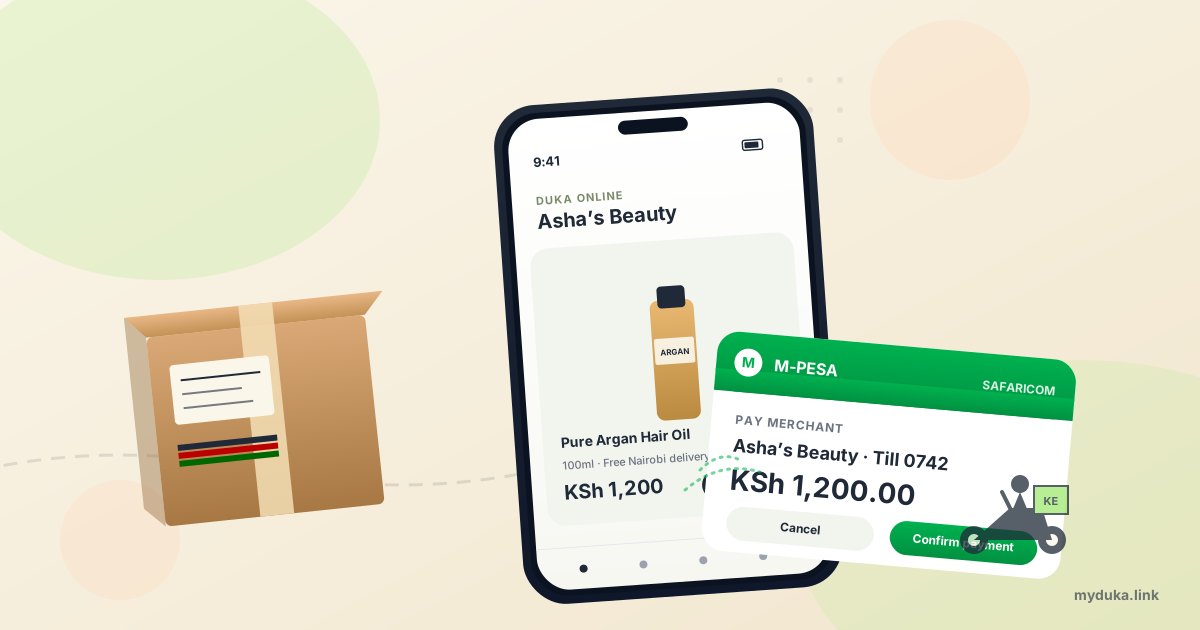
You already run a small biashara. It lives on your phone. Your prices are in your WhatsApp status, your stock photos are in your camera roll, and at least three times a day someone DMs you "How much?" on a product where the price is literally in the caption. You've probably been doing this for six months, maybe two years. The orders are real. The money is real. But the moment you try to grow past your status viewers, things get fuzzy. Should I register the business? Do I need a website? Can M-Pesa Till do that automatically? What about KRA? Will I get arrested? Will I lose money on shipping? Should I just open a Jumia store and call it a day?
This guide is the calm, complete walkthrough you've been looking for. It is written for a Kenyan seller in 2026, not a generic "global entrepreneur." By the end you will know exactly what to register, where to register it, how to take payments, how to ship a parcel from Eldoret to Mombasa without losing your shirt, and how to find your first 100 paying customers without spending a fortune on ads or hiring a developer. Pour some chai. We're going step by step.
1. Decide what to sell
Most online shops in Kenya die in the first three months for one reason: the seller picked the wrong thing to sell. The product chose them, usually because a relative had stock or a TikTok went viral. That's not a business, that's a coincidence.
Run any product idea through four questions. I'll call this the DAMS check: Demand, Access to stock, Margin, Shipping difficulty.
Demand. Are people already buying this in Kenya, today, at the price you intend to charge? Don't guess. Search Jumia for the same product, look at the review counts, scroll Facebook Marketplace, count how many WhatsApp status posts your competitors put up in a week. If nobody is selling it, that's usually because nobody is buying it.
Access to stock. Where do you get the product, how reliably, and how fast? A Gikomba bale supplier you can walk to is access. A Guangzhou agent who replies once a week is not.
Margin. After the stock cost, packaging, M-Pesa fees, and the parcel courier, how much actually lands in your pocket per sale? Below KSh 200 net per sale is brutal. You need volume you probably don't have yet. Above KSh 500 is workable.
Shipping difficulty. Light and unbreakable wins. Heavy, fragile, expensive, or perishable loses.
Three real Kenyan examples, scored honestly:
Mtumba clothes from Gikomba. Demand is permanent. Access is unbeatable, you can be there by matatu. Margin is thin per item, KSh 100 to 300, but volume saves you. Shipping is medium difficulty: light, but sizing returns hurt.
Beauty oils, body butters, and natural skincare. Demand is huge, especially among 22 to 35 year-old women on Instagram and TikTok. Access is decent through local cosmetic wholesalers in Nairobi CBD or imports via Jumia Logistics. Margins are excellent, often 50 to 70 percent on small bottles. Shipping is easy: small, light, hard to damage. This is the easiest beginner category in Kenya right now.
Second-hand phones from Luthuli Street. Demand is enormous. Access is technically easy but quality is rough. You need to know what a real iPhone screen feels like. Margin is tight, 15 to 25 percent, and you can lose months of profit on one bad unit. Shipping is dangerous: high-value parcels get stolen. Returns will eat you alive. Don't start here.
The honest answer for most first-time sellers in 2026: pick something light, high-margin, and visually shareable. Beauty, accessories, kitchenware, simple kids' items. Phones and electronics come later, when you can afford the mistakes.
2. Register your business — sole proprietor or limited company?
You can technically sell on WhatsApp without registering anything. People do it every day. But the moment you want a paybill, a custom domain, an M-Pesa Till in your business name, a courier account, or to apply for any kind of payment gateway with PayPal or Pesapal, you need a registered business. So do it early. It's not hard.
You have two real choices: sole proprietorship or limited company.
A sole proprietorship is you, registered as a business, trading under a business name. It is the right choice for almost every first-time online seller. The paperwork is simple, the registration is fast (usually within a week if your name search clears), and you file taxes as an individual. The tradeoff is that you and the business are legally the same person. If the business gets sued, you get sued.
A limited company is a separate legal entity. You're a director, the company owns the assets, the company pays its own corporation tax, and your personal assets are protected. It costs more to set up, takes longer, and you'll need to file annual returns even in a quiet year. It is worth it if you have business partners, you plan to apply for big contracts (most government tenders require an Ltd), or you're raising money. For a one-person duka selling beauty oils on Instagram, it's overkill in year one.
Both routes go through the Business Registration Service (BRS) via eCitizen. The flow is roughly:
- Do a business name search on the BRS portal to confirm your chosen name is free.
- Reserve the name once it clears.
- Submit the registration form (sole prop is one page; Ltd needs articles and director details).
- Pay the official fees on eCitizen, download your registration certificate.
I'm deliberately not quoting fees because the BRS adjusts them and you'll see the live amount on the portal at checkout. Pay only through the eCitizen portal. Anyone in a WhatsApp group offering to "fast-track" your BRS registration for KSh 8,000 is selling you a service you can do yourself in an evening. We've written a full walkthrough on how to register your business with KRA if you want the step-by-step.
After BRS, you need a KRA PIN, which is free on iTax. If you already have a personal KRA PIN, that's enough for sole prop trading. A limited company gets its own separate PIN.
Last piece: the Single Business Permit from your county. Technically every business needs one based on its physical location, even if you only sell online. In practice, county enforcement on home-based online sellers is uneven. The honest advice: once you have a real location (a small office, a stockroom, or you start hiring), get the permit. Before that, prioritise BRS and KRA first.
3. Set up your online shop
You have four real options as a Kenyan seller in 2026. I'm ranking them by how often I see them actually work, not by who pays for ads.
1. WhatsApp Business catalog. Free, takes an afternoon, sells on the same number your customers already chat you on. You add products with photos and prices to your catalog, share the catalog link on status, and people order in DMs. The downsides: no automatic checkout, no M-Pesa STK Push, no inventory tracking, no abandoned-cart recovery, no Google search traffic. Great as a starting point. Painful at scale. We've written more about combining WhatsApp Business + a shop link for sellers who want both.
2. Jumia Mall (as a seller). Free to list, but Jumia takes a category commission of roughly 12 to 15 percent on every sale, plus payment processing. Approval takes weeks, and Jumia owns the customer relationship. You don't get the buyer's phone number, only an order ID. Useful if you can't be bothered with marketing and your category has organic Jumia traffic, painful if you ever want to build a brand.
3. Custom-built website. A developer charges KSh 50,000 to 200,000 to build something on WordPress or Laravel, plus hosting, plus an M-Pesa integration, plus maintenance every time something breaks. You get full control. You also get every late-night "the site is down" call. Only worth it if you have an unusual workflow that no platform handles, or you're already past KSh 500K a month and need bespoke features.
4. All-in-one Kenyan ecommerce platform. Shopify is the global option but starts around USD 29 a month (roughly KSh 4,000) and needs a separate paid M-Pesa app, which makes the real monthly cost closer to KSh 6,000 to 8,000 once you're done. The Kenyan-built alternative is free Kenyan online shop builder MyDuka, which has a free tier that lets you list up to 10 products and a Pro plan at KSh 1,000 a month for unlimited products and a custom domain. It supports M-Pesa STK Push directly via your own Daraja API keys (you apply for these from Safaricom yourself, so transactions go straight into your Till), or via PayHero if you don't want to deal with Daraja onboarding. It also supports Pesapal, Stripe, PayPal, and cash on delivery, and includes an "Order via WhatsApp" button on every product page for customers who prefer to chat first. If you're comparing platforms, our deeper write-up on the Shopify alternative for Kenyan sellers covers the tradeoffs.
Here's the honest comparison:
| Option | Setup time | Monthly cost (KSh) | Commission per sale | Customer data | M-Pesa STK Push |
|---|---|---|---|---|---|
| WhatsApp Business | 1 afternoon | 0 | 0% | You own it | No (manual) |
| Jumia | 2 to 4 weeks (approval) | 0 | 12 to 15% + payment fee | Jumia owns it | Yes (via Jumia) |
| Shopify + M-Pesa app | 1 to 2 days | ~6,000 to 8,000 | 0% | You own it | Yes (via paid plugin) |
| MyDuka (Pro) | 1 evening | 399 | 0% | You own it | Yes (your own Daraja or PayHero) |
| Custom site | 4 to 12 weeks | 5,000+ hosting | 0% | You own it | Yes (custom build) |
Recommendation matrix:
- You have 10 or fewer products and zero budget → WhatsApp Business catalog. Master one channel before paying for two.
- You have 10+ products, want a real shoppable link, and want STK Push → an all-in-one platform. MyDuka if you want a Kenyan-built option, Shopify if you plan to sell internationally.
- You have KSh 50,000+, a developer on WhatsApp, and weird requirements → custom build.
4. Take payments — M-Pesa, cards, PayPal, and cash
M-Pesa is not a payment option in Kenya. It is the payment option. If your shop can't accept M-Pesa with one tap, you will lose sales every single day.
M-Pesa STK Push is the experience customers expect: they enter their phone number on your checkout, a prompt pops up on their phone, they enter their M-Pesa PIN, money lands in your Till, the order is confirmed automatically. To enable it on your own platform, you apply for the M-Pesa Daraja API on the Safaricom developer portal, get production credentials (consumer key, consumer secret, passkey, shortcode), and plug them into your shop's settings. Sandbox keys are free and instant; production keys require Safaricom to approve your Till and can take a couple of weeks. Buy Goods Tills are free for customers; the seller pays Safaricom's standard transaction fee per collection. We've documented the full process in our M-Pesa Daraja API integration guide.
If applying for Daraja directly feels like too much paperwork, PayHero acts as a friendlier middle layer. You sign up, connect your Till, and they handle the Daraja call for you. They take a small per-transaction fee on top of M-Pesa's, but you skip the production-key application. Many sellers start with PayHero and graduate to direct Daraja once volume justifies it.
Pesapal and Flutterwave sit in a different category: they aggregate Visa, Mastercard, and M-Pesa into one checkout, which matters if you sell to Kenyan corporate buyers (who pay by card) or to the diaspora. Their pricing is in the 3 to 4 percent range per transaction. Worth adding once you've outgrown M-Pesa-only buyers, not on day one.
PayPal is the question every Kenyan seller eventually asks. The honest answer: you can receive PayPal payments in Kenya, but withdrawing is the awkward part. PayPal lets you send money from your PayPal balance to your registered M-Pesa number through the PayPal Mobile Money service, with monthly limits and a small fee. It is not as smooth as people assume. Add PayPal only if you genuinely sell to international customers; otherwise it adds a checkout option that converts at 1 percent and confuses everyone else.
Cash on delivery still works in 2026, especially in urban estates and for orders under KSh 3,000 where customers don't want to risk paying upfront. The catch: courier failure rates on COD parcels run around 15 to 20 percent (customer not home, changes mind, gives wrong address). Build that into your prices. Pad COD orders by 10 to 15 percent to cover the bounces, or charge a non-refundable KSh 200 commitment fee at order placement so the customer has skin in the game.
The minimum stack for a Kenyan online shop in 2026 is M-Pesa STK Push plus cash on delivery. Add Pesapal once you're regularly invoicing companies. Add PayPal only when a real international customer asks.
5. Shipping and fulfilment across Kenya
Shipping breaks more new online shops in Kenya than payments do. The seller quotes a flat KSh 200 delivery to "anywhere in Kenya," ships their first parcel from Nairobi to Bungoma, the courier charges KSh 850, and the entire profit on that order vanishes. Get this right early.
These are realistic 2026 price ranges per parcel. Couriers move their pricing every quarter, so use these as a planning baseline, not a quote. For a deeper side-by-side, see our piece where we compare Kenyan courier services.
G4S Courier. The reliable workhorse for documents and small parcels. Nairobi-to-Nairobi runs roughly KSh 250 to 500 depending on size. Nairobi to a county capital (Mombasa, Kisumu, Eldoret, Nakuru) is roughly KSh 350 to 700, next-day. Good tracking, a real office network, slightly more expensive than the alternatives.
Sendy. Strongest for same-day Nairobi delivery via boda. Small parcels run KSh 200 to 450 within Nairobi, and they handle van deliveries and inter-county runs in the KSh 350 to 1,200 range. The app is solid, you can dispatch in seconds, drivers know the city.
Wells Fargo Courier. The classic county-to-county overnight option, with branches in almost every town. Cost is in the KSh 250 to 600 band per parcel for standard size. Customer picks up at the destination branch. Old-school but it works, especially for upcountry deliveries where last-mile is unreliable.
Pickup Mtaani. Customer collects from a neighbourhood agent (a kiosk, a salon, a phone shop) instead of a doorstep delivery. Price is the lowest in the market, often KSh 100 to 200 per parcel, because there's no last-mile leg. Excellent for low-value items and for customers in dense estates. The catch: customer must walk to the agent, which loses you the convenience-led buyer.
Speed Air and SGR cargo. For valuable or fragile items going to the coast or western Kenya, airline cargo or the SGR passenger train cargo service moves parcels in under a day for KSh 500 to 1,500. Overkill for a KSh 800 lipstick, sensible for a KSh 25,000 phone.
Self-delivery via boda in Nairobi. Works at low volume. You hire a regular boda guy, pay him KSh 150 to 300 per drop, and you keep the courier margin. It collapses around 10 to 15 deliveries a day, when scheduling, returns, and confirmations start eating your time. Use it for the first month, switch to a real courier once orders are predictable.
A practical shipping policy that doesn't lose money: charge a flat Nairobi rate (KSh 300 covers most boda deliveries inside the city), a flat county rate (KSh 500 covers most overnight courier deliveries to county capitals), and quote remote areas individually. Never offer "free shipping" unless you've baked the cost into the product price. Free shipping is a marketing line, not an accounting choice.
6. Get your first 100 customers
Most online business advice from American YouTubers will tell you to "build a sales funnel" and "run Facebook ads." That advice is fine, somewhere. In Kenya in 2026, your first 100 customers will almost certainly come through five free or near-free channels, in this rough order of importance.
WhatsApp status. This is the single most underrated sales channel in Kenya. Real Kenyan small-shop data from sellers I've worked with suggests WhatsApp status drives somewhere around 40 to 60 percent of repeat orders for shops under KSh 200K monthly revenue. The rules: post 5 to 8 statuses a day, mix product photos with screenshots of customer messages ("Mtumba dress arrived, fits perfectly"), behind-the-scenes (you packing parcels, you at Gikomba), and a daily "available stock" recap. Don't post all eight in one go at 9am. Spread them through the day so you stay near the top of viewers' status reels.
Instagram organic + paid. Reels are the format that still works in 2026. Three reels a week is the floor. For paid, start at KSh 200 a day, run two creative variations against each other, kill the loser after 72 hours, double the budget on the winner. The rookie mistake is spending KSh 5,000 on one boosted post; you learn nothing and spend everything. Spend slowly, learn what your audience clicks, then scale.
TikTok organic. Free reach is still real on TikTok in Kenya, especially for product demos. A 15-second video of a hair oil being applied, a kitchen gadget being used, a phone case being snapped on, can move thousands of views with zero budget. Post daily for 30 days before judging. Tag your location (Nairobi, Mombasa) so the algorithm shows you to local viewers.
Google Business Profile. Free, drives walk-in customers if you have any physical presence, and shows up on Google Maps when somebody searches "beauty shop near me." List your business name, hours, services, and at least 10 photos. Ask every happy customer to leave a review. Reviews compound; a profile with 30 five-star reviews outranks a competitor with 5 reviews even if you're physically further away.
Referral incentives, the M-Pesa-friendly version. The mistake sellers make is sending KSh 200 cashback via M-Pesa to anyone who refers a friend. You'll lose your shirt. The version that works: give the referrer a discount code for KSh 200 off their next order, and give the new customer KSh 100 off their first order. Both incentives only redeem when money flows back to you. Tracked through promo codes inside your shop, this is the cheapest customer acquisition channel in Kenya.
The order matters. Pour your first 60 days into WhatsApp status and TikTok. Add Instagram paid in month two when you have content that has already proven it works organically. Set up your Google Business Profile in week one and forget about it for a month.
7. Stay legal — KRA, ODPC, and consumer protection
Three legal things matter for an online seller in Kenya. None are scary if you set them up early.
KRA tax. Once you're registered, you have to file. The two main regimes that touch online sellers are Turnover Tax and VAT. Turnover Tax applies to small businesses within KRA's defined turnover band (in 2026 this is roughly KSh 1 million to KSh 25 million annual gross — verify the current threshold on kra.go.ke before filing) at a flat 3 percent of gross monthly sales, filed monthly via iTax. Below the lower band, you may be exempt from Turnover Tax but still need to file an annual return showing nil or low income. VAT registration becomes compulsory once your annual taxable turnover crosses KSh 5 million; below that, you can register voluntarily but most small sellers shouldn't bother. Our companion piece on KRA tax for online businesses walks through filing month by month.
Office of the Data Protection Commissioner (ODPC). If you collect customer names, phone numbers, addresses, and use them for marketing (which any real online shop does), the Data Protection Act 2019 says you should register as a Data Controller with ODPC. Annual registration fees are tiered by business size. The penalties for non-registration are real once a customer complains, even if enforcement on small sellers has been gentle so far. Register once you have more than a few hundred customers in your database.
Consumer Protection Act 2012. The headline rules every online seller should respect: prices must be displayed clearly (this is why "inbox for price" is genuinely illegal, not just bad marketing), promises in your ads must be honoured, defective goods must be refunded or replaced within a reasonable period (7 days for clear defects is the practical standard), and misleading claims about country of origin or quality can land you a complaint at the Competition Authority of Kenya. Write a simple returns policy on your site and stick to it.
8. Common mistakes that kill small online shops
Five mistakes I see kill more Kenyan online shops than any other.
1. "Inbox for price." Every time a customer has to send a message to find out the cost, your conversion drops sharply. Industry data on Kenyan WhatsApp commerce suggests "inbox for price" listings convert at roughly 40 percent lower rates than listings with the price on the photo. Always show the price.
2. Mixing personal M-Pesa with business M-Pesa. When your rent money sits in the same Safaricom line as your stock money, you'll spend stock money on rent at month-end and not realise it until you can't restock. Open a Buy Goods Till in the business name. It costs nothing and saves your business.
3. No stock tracking. You sell out, you don't notice, a customer pays, you reply two days later "samahani, out of stock," and they refund-and-block. Even a Google Sheet with one row per SKU and a current count beats nothing.
4. Free shipping you can't afford. "Free delivery countrywide" looks great in your bio, then a Bungoma order costs you KSh 850 in courier fees on a KSh 1,200 product and you start ghosting customers because every reply costs you money. Charge real shipping, transparently, from day one.
5. Posting once and disappearing. You post a product on status Monday, get no orders, decide social media doesn't work, and don't post again until Friday. The WhatsApp status algorithm and the human brain both forget you within 24 hours. Daily posting is the floor, not the ceiling.
9. Frequently asked questions
Do I need a registered business to sell online in Kenya?
Technically you can sell on WhatsApp without registration, and many people do. But the moment you want a Buy Goods Till in the business name, an M-Pesa Daraja account, a Pesapal account, or to sign up for a payment gateway, you need a registered business. You also need it to file taxes properly. Register a sole proprietorship through the Business Registration Service via eCitizen as soon as you're earning a regular income. It's the cheapest, fastest type of registration and covers you for almost everything an online seller needs in year one.
How much money do I need to start an online business in Kenya?
Honestly, very little if you start lean. KSh 5,000 to 15,000 covers your first batch of stock for a small product like beauty oils or accessories, plus your business registration. Add KSh 1,000 a month if you use a paid platform like MyDuka Pro for unlimited products. Add KSh 200 a day once you start running Instagram ads. The mistake is spending KSh 50,000 on a custom website before you have a single confirmed buyer. Start with the cheapest version that takes real money, prove that people will pay you, then reinvest.
Can I start an online business in Kenya without a website?
Yes. WhatsApp Business with a product catalog and Instagram with prices on every photo are enough to do KSh 50,000 to 200,000 a month. A real shop website becomes useful once you have more than 10 to 20 products, want automatic M-Pesa STK Push, or want Google search traffic. Below that, a website is a vanity project. The order is: prove the product on WhatsApp, then graduate to a platform with a real checkout when manual order-taking starts eating your evenings.
What is the cheapest way to take payments in Kenya?
A Buy Goods Till from Safaricom. Customers pay you through Lipa na M-Pesa with no charge to them, and you pay Safaricom's standard transaction fee. There's no monthly subscription. The next-cheapest layer is automating those Till payments through STK Push using your own Daraja API keys, which costs nothing to apply for, just paperwork. PayHero adds a small per-transaction fee on top but skips the Daraja application. Avoid Pesapal and Flutterwave on day one. They're great products, but their 3 to 4 percent per transaction is overkill until you have card-paying customers.
How long does KRA registration take?
Getting a KRA PIN on iTax is instant if your ID details match. You fill the online form, upload your ID, and the PIN certificate is emailed to you within minutes in most cases. If your ID record has any inconsistency, it can take a few days at a Huduma Centre to correct, then another hour for the PIN. Business KRA registration once your BRS certificate is ready is similarly same-day on iTax. The slow part is BRS itself, which usually takes a few working days for a sole proprietorship name to be approved and gazetted.
Do I need to pay tax on my online shop income?
Yes, if your business earns above the KRA's exemption threshold. The two main regimes for small online sellers are Turnover Tax (a flat percentage on gross sales for businesses inside KRA's turnover band) and VAT (compulsory once your annual taxable turnover crosses KSh 5 million). Below the Turnover Tax band, you should still file an annual return showing your income, even if no tax is owed. Don't skip filing. KRA imposes penalties for non-filing that compound monthly. An hour with a small accountant once a year, costing KSh 3,000 to 5,000, is the cheapest insurance you can buy.
What's the best platform to start an online shop in Kenya in 2026?
For absolute beginners with under 10 products and zero budget: WhatsApp Business catalog. For sellers who want a real shoppable link, automatic M-Pesa STK Push, and their own customer database: an all-in-one platform like MyDuka or Shopify. MyDuka is built for Kenya, has a free 10-product tier, and lets you connect your own Daraja API keys so M-Pesa payments go straight into your Till. Shopify is the global option and worth it if you plan to sell internationally. Avoid custom-built websites unless you have a developer on your team and over KSh 50,000 to spend.
Can I run an online shop from a county outside Nairobi?
Yes, and it's getting easier every year. Couriers like G4S, Wells Fargo, and Pickup Mtaani have agent networks across all 47 counties. Your stock can sit in Eldoret, Kisumu, or Meru, and you can ship countrywide. The two challenges outside Nairobi are last-mile boda delivery (less developed than in the city, so plan for branch pickup at the destination) and Instagram ad targeting (Kenyan ad audiences cluster heavily around Nairobi and Mombasa). Lean on TikTok and WhatsApp status, both of which spread organically by location.
How do I deliver products outside Nairobi?
The reliable options are courier services with branch networks. Wells Fargo, G4S, and Easy Coach Cargo all run county-to-county overnight. Customer collects from the destination branch, which is normal in Kenya and adds no friction. For doorstep delivery upcountry, use Sendy or a courier with last-mile partners, and expect to pay KSh 500 to 1,200 per parcel depending on weight and distance. Pickup Mtaani is expanding into more counties and is the cheapest option if your customer is near one of their agents.
How do I find my first customers?
Start with the people who already know you exist: your WhatsApp contacts, your Instagram followers, your Facebook friends. Post your products on WhatsApp status 5 to 8 times a day for a week. Ask three friends to share your status to theirs. Make one TikTok demo of your product being used. Set up a free Google Business Profile. Don't spend a shilling on ads in week one. Your first 20 customers will come from your existing network and from one or two TikToks that take off. Customers 21 to 100 come from the social proof those first 20 generate when they tag you, leave reviews, and post their parcels.
10. Your next step
You've now read more about starting an online business in Kenya than 95 percent of the people who will ever try. You probably feel a little overloaded. That's normal. The cure is to do the smallest possible next thing.
Pick one product. Just one. Take three good photos with your phone, in natural light, against a clean wall. Write the price clearly on the first photo. Set up a free shop on MyDuka, list the product, share the link on your WhatsApp status with the caption "Available, KSh X, M-Pesa accepted, delivery countrywide." That's it. You will know within 48 hours whether you have a business. Everything else, the registration, the courier accounts, the ads, the FAQs, all of that comes after the first sale, not before it.
The shop won't open itself. Go.