You've taken sharp photos, your prices are right, and your shop loads fast. Customers tap a product, scroll past the photo, and... read three lines that say "Pure argan hair oil. 100ml. Available." Then they leave. Not because the product is wrong. Because the description didn't give them enough to feel confident clicking buy.
Product descriptions are the most-skipped, most-undervalued surface on a Kenyan online shop. The shops that get them right convert at 2 to 3 times the rate of shops that don't, with the same photos and the same prices. This guide walks through how to write them, in the order they should appear on the page, with real Kenyan examples. If you're still building the shop itself, our complete guide to starting an online business in Kenya covers the rest.
The shape of a great product description
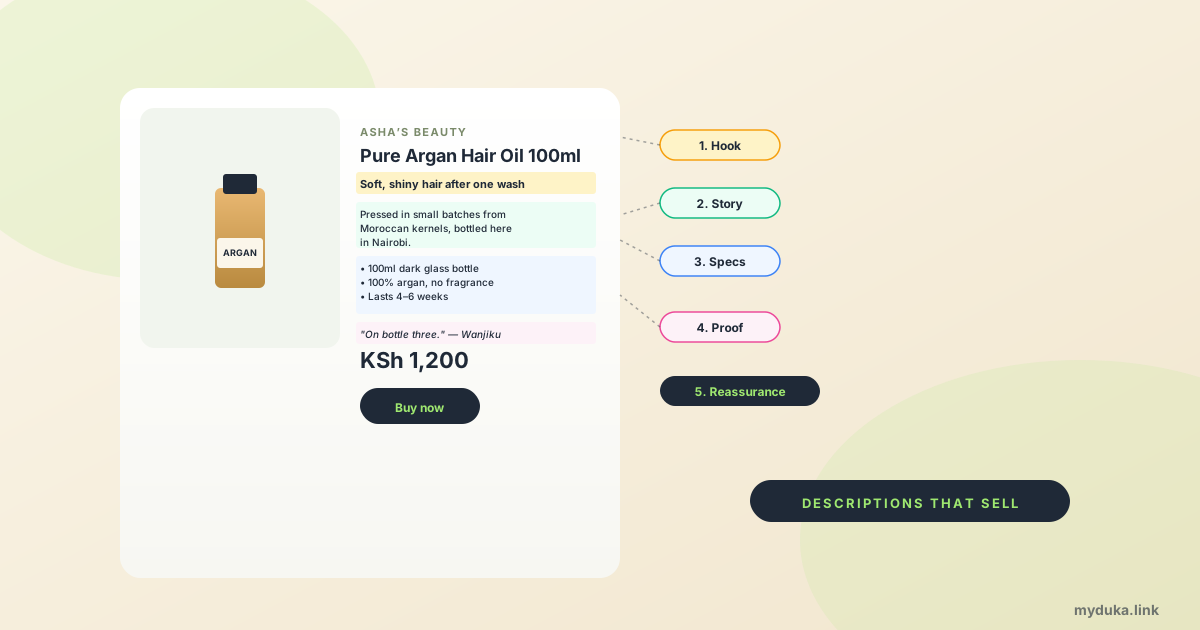
Every effective product description has the same five parts, in the same order. They map to the questions a Kenyan shopper asks in their head, in sequence:
- The hook (1 line): what is this and why should I care, in one sentence.
- The story (2–3 lines): who it's for, when to use it, what makes it different.
- The specs (5–8 bullets): the practical details — size, ingredients, materials, what's in the box.
- The proof (1–2 lines or one quote): why customers trust it.
- The reassurance (1 line): how delivery, returns, and payment work.
Total: 80 to 150 words. Skim-able on a phone, complete enough to close the sale.
Part 1: The hook
Don't start with the product name — that's already in the page heading. Start with the result the customer wants. Compare:
Weak: "Pure Argan Hair Oil 100ml."
Strong: "Soft, shiny hair after the first wash, without the sticky build-up."
The hook addresses the customer's actual desire (soft, shiny hair) and a known objection (the sticky build-up that bad oils leave). Anyone who has used a hair oil understands both halves immediately.
Examples by category:
- Beauty oil: "Soft, shiny hair after one wash, no sticky build-up."
- Mtumba dress: "A weekend dress that fits like it was sewn for you."
- Phone case: "Drops survive. Pockets thank you."
- Kitchen knife: "Slice tomatoes thin enough to read through."
The hook should pass one test: read it aloud. If it sounds like a product description, rewrite. If it sounds like the seller talking to one specific customer, ship it.
Part 2: The story
Two to three lines. Who is this for, when do they use it, what's different about it from the alternatives. Don't list every feature — that comes next. Set the context.
Example for the argan oil: "Pressed in small batches from Moroccan argan kernels, then bottled here in Nairobi. Use 2–3 drops on damp hair after every wash. Lasts 4 to 6 weeks for most people."
Three sentences. Origin (Moroccan, bottled in Nairobi — locality matters to Kenyan shoppers). Use (after every wash, 2–3 drops — practical instruction). Duration (4 to 6 weeks — answers "is this worth KSh 1,200?").
Example for a mtumba blazer: "Vintage Italian wool, sourced from Gikomba, dry-cleaned and steamed before shipping. Pairs with everything from chinos to ankara. Sized true to UK Medium."
Origin (Italian wool from Gikomba — the kind of detail that signals you know your stock). State (dry-cleaned and steamed — answers the unspoken "is this clean?" objection). Versatility (chinos to ankara — gives the customer permission to imagine wearing it).
The story is where you sell the experience, not the object.
Part 3: The specs
Five to eight bullet points covering the practical details. Bullets, not paragraphs. Mobile shoppers scan; they don't read.
Example for the argan oil:
- 100ml dark glass bottle with dropper
- 100% argan oil, no fragrance, no parabens
- Lasts 4 to 6 weeks for most users
- Cold-pressed, single ingredient
- Suitable for all hair types and natural hair
- Made in Kenya, batch-numbered
Each bullet answers an unspoken question. "100ml" answers "how much is in the bottle." "No fragrance, no parabens" answers "will this irritate my scalp." "Batch-numbered" answers "is this counterfeit." Every bullet should resolve a real concern, not just describe.
For clothing: include sizing details, care instructions, fit (slim/regular/relaxed), fabric composition, country of origin.
For electronics: include compatibility, warranty length, what's in the box, battery life if relevant.
For food: include ingredients, allergens, weight, shelf life, storage instructions.
Part 4: The proof
One or two lines, or one short quote. The job here is to lower the customer's risk perception. Three formats that work:
Numbers: "Stocked by 12 salons in Nairobi. Repurchase rate: 68%."
A real review: "'Smelled subtle, lasted longer than my last bottle. I'm on bottle three.' — Wanjiku, Westlands."
A quiet credential: "Featured in Drum Magazine's 2025 home & beauty issue."
If you don't have any of these yet, skip this section rather than fake it. Fabricated reviews are spotted and they cost you more than the absent proof would.
Part 5: The reassurance
One line that handles delivery and returns. Customers want to know "what happens if this goes wrong" before they commit.
Examples:
- "Free Nairobi delivery on orders over KSh 5,000 — KSh 300 otherwise. 7-day returns if unopened."
- "Ships next-day countrywide via G4S. Returns accepted for damaged or wrong items."
- "Pickup available in Westlands; delivery KSh 250 within Nairobi. M-Pesa STK Push at checkout."
One line. Resolves the "what if" question before it becomes a reason to leave.
Speaking your customer's language
Two specific Kenyan-English habits to lean into:
Use "you," not "the customer." "You'll notice softer hair within a week" beats "Customers report softer hair within a week." The first is a friend talking to you. The second is a brochure.
Drop a Swahili word where it would naturally appear. "Ships countrywide kabisa" or "Pure as a mboga, no chemicals" land warmer than the same lines in pure English. Don't force it. One Swahili word per description, in a place a friend would actually use it, beats five forced ones.
Use real KSh figures where the price discussion fits. "Lasts 4 weeks at KSh 300/week of use" reframes the price into a daily cost the customer can compare to their morning chai.
SEO basics for product pages
Most Kenyan online shops never appear on Google search results because they leave the SEO basics empty. The five things that matter:
- Product title: include the category word ("argan oil," "leather wallet," "iPhone case") plus a unique modifier ("organic," "men's slim fit," "iPhone 15 Pro"). Bad: "Bottle." Good: "Pure Argan Hair Oil 100ml — Cold-Pressed, Made in Kenya."
- Meta description: 150 to 160 characters. Repeat the hook from your description, plus a price hint and a call to action.
- Image alt text: describe what's in the photo, including the product name. "Pure argan hair oil 100ml dark glass bottle on wooden table." Lifts your photos in Google Image search.
- URL slug: short, lowercase, hyphenated, includes the product name. "pure-argan-hair-oil-100ml" beats "product-id-12345."
- Long enough description: at least 80 words. Pages with under 50 words of description rarely rank for anything.
Most modern shop platforms — including MyDuka — fill these in for you with sensible defaults. Override them on your top 10 products by hand for the lift.
Mobile readability
Almost every shopper reading your description is on a phone, with one hand, while doing something else. Three rules:
- Short paragraphs. 1 to 3 lines maximum. Walls of text get scrolled past.
- Bullet specs. Always bullets, never paragraphs of features.
- One emoji per description, max. Used as a visual anchor, not decoration. ✨ for premium, 🌿 for natural, 🇰🇪 for Made in Kenya. More than one and you look like a teenager.
Common mistakes
"Inbox for details." Same family as "inbox for price." Every time a customer has to ask you for information that should be in the description, conversion drops. Put it on the page.
Repeating the title in the first line of the description. "Pure Argan Hair Oil 100ml is a 100ml bottle of pure argan oil." Wastes the most valuable line on the page. Lead with the hook.
"World-class," "premium," "high-quality." Empty marketing words customers ignore. Replace with specifics. Not "premium leather" but "vegetable-tanned cowhide from Eastleigh." Not "high-quality fabric" but "100% Egyptian cotton, 200gsm."
Copy-pasting the supplier's description. Every other reseller is using the same words. Your shop becomes interchangeable. Rewrite in your voice, even if just the hook and the story.
Burying the price elsewhere. If the price is only in the cart, customers leave. Make sure your description acknowledges value: "At KSh 1,200 you're paying KSh 30 per use over the lifetime of the bottle."
FAQ
How long should a product description be?
80 to 150 words for most products. Long enough to cover hook, story, specs, proof, and reassurance; short enough to read on a phone. Below 50 words you're losing both shoppers (not enough info) and Google (too thin to rank). Above 200 words, customers stop reading.
Should I write product descriptions in English or Swahili?
Primarily English, with a sprinkle of Swahili where it lands naturally. The vast majority of online searches in Kenya are in English; you want to be findable. But a single Swahili word per description ("kabisa," "mboga," "tu") signals "this is a Kenyan shop" and lifts trust noticeably.
Can I copy a competitor's product description?
No. Beyond being plagiarism (which Google can detect and penalise), it makes your shop interchangeable with theirs. The whole point of a description is to differentiate. Spend 10 minutes per product writing your own. The lift in conversion pays for the time within a week.
What's the most important sentence in a product description?
The first one — the hook. Most shoppers read the first line and decide whether to keep reading. If your hook is "Pure Argan Hair Oil 100ml" you've already lost the half-skim shopper. If it's "Soft, shiny hair after one wash" you've earned the next ten seconds.
Should I include reviews in the description?
One real review is worth ten lines of self-praise. Quote one customer (with permission and attribution) inside the description text, and let the platform's review widget handle the rest underneath. Don't fake reviews — Kenyan shoppers spot them and the trust drop is permanent.
How do I write descriptions for products I have many of, like mtumba?
Write a template description for the category (the story, specs, proof, reassurance) and customise only the hook and the size/condition specifics for each item. Saves you 80% of the writing time without sacrificing differentiation.
Your next step
Open your three best-selling products tonight. Replace each description with the five-part structure: hook, story, specs, proof, reassurance. 30 minutes of work. Compare conversions next week. If you also need to upgrade the photos sitting next to those descriptions, see our smartphone product photography guide.