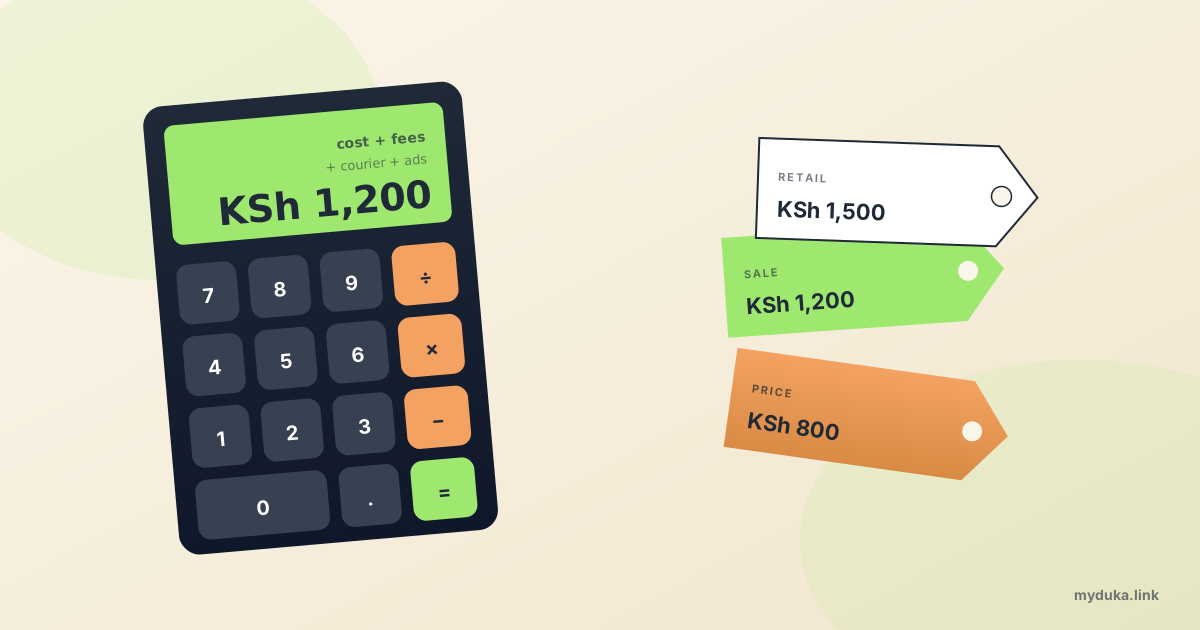
Most Kenyan online shops that fold in their first year don't fold because of demand, traffic, or shipping. They fold because the seller priced too low, sold a lot, ran out of stock, and discovered there was no money left to restock. By the time they noticed, the business was a hobby with a growing pile of M-Pesa receipts and an empty bank account.
This guide walks through how to price products on a Kenyan online shop in 2026 without making that mistake — what costs to actually count, how to research competitors honestly, the small psychology that lifts conversion, and when to raise prices without losing customers. If you haven't set up the rest of the picture yet, our complete guide to starting an online business in Kenya covers payments, shipping, and registration.
The full cost of selling one item, in Kenya, in 2026
The seller writes "stock cost KSh 400, I'll sell at KSh 800" and feels good about a 100% margin. Two months later they wonder where the money went. Real cost of selling one KSh 800 item to one Kenyan customer:
- Stock cost: KSh 400.
- Packaging: KSh 30 to 50 — bubble wrap, branded tissue, mailer bag, sticker.
- M-Pesa fee: KSh 22 to 33 on a KSh 800 Buy Goods collection (Safaricom rates depend on the band).
- Courier fee, if you offer "free delivery": KSh 250 to 850 depending on destination.
- Cost of returns / replacements: ~5–8% of orders fail, costing you the parcel back-and-forth and sometimes the product.
- Marketing cost per sale: if you spend KSh 5,000 on Instagram ads to make 25 sales, your cost per acquisition is KSh 200.
Add it up. A "100% margin" KSh 800 product that includes free delivery to Mombasa actually nets you... about KSh 50, sometimes negative. The margin maths nobody teaches you is the only maths that matters.
The honest formula:
Selling price = (stock cost + packaging + payment fee + courier + returns reserve + ad cost) × markupFor a healthy small Kenyan shop, your markup on top of all-in cost should be 1.5× to 2.5×. Below 1.5×, you're not earning enough to grow. Above 2.5×, you're often pricing yourself out of the market for everyday goods.
How to research competitors without copying them
The wrong way: open Jumia, look at the cheapest listing, undercut it by KSh 50. You will lose. The cheapest listings on Jumia are often resellers with bulk discounts you can't access, or sellers willing to lose money on visibility.
The right way:
- Find 5 to 7 sellers in your category, not the top 30. Look on Jumia, Instagram, WhatsApp groups, TikTok shop. Pick a mix — established and new, branded and generic.
- Note their full price, including their delivery charge. A KSh 700 product with KSh 400 delivery costs the customer KSh 1,100. Compare apples with apples.
- Note what's around the price. Are their photos better than yours? Do they have reviews? A faster reply time? Branded packaging? Those things justify a 15–30% premium.
- Ignore the cheapest 20%. They're either dumping stock, mislabelling product origin, or losing money. You can't compete on price you don't have.
- Position around the median. Most successful Kenyan small shops sit at the median or slightly above, not at the bottom.
Pricing is positioning. If you're 10% above the market with a clearer photo, faster reply, and branded packaging, customers buy from you. If you're 30% below the market with grainy photos and no profile, customers assume the product is fake.
Psychological pricing that works in Kenya
A few small choices lift conversion at no cost. They work because they match how Kenyan shoppers read prices, not because they're tricks.
Use round shillings, not 99s. KSh 1,200 converts better than KSh 1,199 in Kenya. The 99-tactic is American supermarket DNA. Kenyan shoppers see KSh 1,199 and read it as "trying too hard." KSh 1,200 reads as confident.
Show shipping clearly, separate from product price. "KSh 1,200 + KSh 300 delivery" converts better than "KSh 1,500 free delivery." Shoppers want to feel they could pick up the product themselves and save the delivery fee.
Anchor with a higher option. Putting your KSh 1,200 product next to a KSh 2,500 premium version makes the KSh 1,200 look reasonable. Sellers without a premium SKU are leaving money on the table.
Use comma separators. "KSh 12,500" reads faster than "KSh 12500." Most Kenyan shop platforms format this automatically.
Bundle smaller items. Two products at KSh 800 each = KSh 1,600 total. The same two as a "duo bundle" at KSh 1,500 raises your average order value 10% AND feels like a deal.
Sale pricing without losing money
"Buy one get one free" sounds generous and often is — for the customer. For the seller, two units at half price is identical to a 50% discount on one. Run that sale on a low-margin product and you're paying customers to take stock off your hands.
Sale rules that protect your margin:
- Discount the original price, not your selling price. If your normal margin is 1.8× cost, a 20% discount eats into margin but still leaves you profitable. A 50% discount can put you below cost.
- Run sales on overstock, not best sellers. Best sellers are already moving — discounting them just gives away margin. Sales should clear inventory, not subsidise the rich.
- Time-bound sales. "20% off until Sunday" creates urgency. "20% off forever" trains customers to wait for the discount price as the new normal.
- Bundle sales beat percentage sales. "Buy 3 oils, save KSh 500" feels generous and lifts your average order value. "10% off everything" feels generic and lowers it.
- Use coupon codes for negotiated discounts. A code keeps the public price intact while letting you negotiate with corporate buyers, friends, or repeat customers.
When to raise prices (and how to do it without losing customers)
Most small sellers raise prices too late. They watch supplier costs creep up, courier rates change, M-Pesa fees adjust, and they keep absorbing the loss "until things settle." Things never settle. Inflation in Kenya runs 5–8% most years; if your prices haven't moved in 18 months, you've quietly given yourself a 12% pay cut.
Plan to raise prices once every 12 to 18 months at minimum, by 5–10%. The mechanics:
- Tell customers in advance. A WhatsApp status post, an Instagram reel: "Prices going up by 7% on the 1st — beat the change." This often increases sales in the two weeks before the increase.
- Update everywhere on the same day. Your shop, WhatsApp catalog, Instagram bio. Conflicting prices destroy trust.
- Hold the new price. Don't reverse course because three customers complained in the first week. By month two the noise stops; the new baseline is normal.
- Add value, not just price. Pair the price increase with something — slightly bigger size, branded packaging, a free sample for first orders. The increase reads as a quality jump, not greed.
Pricing your services and digital products
If you sell services (consulting, tailoring, lessons) or digital products (e-books, design templates, courses), the cost-plus formula doesn't apply. You're pricing your time and expertise. Two practical rules:
Price by value, not by hour. "Logo design — KSh 8,000 fixed" beats "KSh 1,500 per hour" because clients can budget. Hourly billing also caps your earnings at the hours in a week.
Triple the lowest price you'd accept. If you'd grudgingly say yes at KSh 5,000, list at KSh 15,000. Most clients pay close to list, the cheapskates self-filter, and you keep your sanity.
Common pricing mistakes I see kill Kenyan shops
Pricing for the cheapest customer. 80% of your stress comes from the 20% of customers haggling for KSh 100 off. Price for your real customer, not the haggler.
Free shipping countrywide on a KSh 800 product. A Bungoma delivery costs you KSh 850. You lose KSh 50 on the sale. Multiply by 50 sales a month, you're losing KSh 2,500. Rather charge real shipping or build it into the price honestly.
Matching the cheapest competitor without their volume. They buy in bulk, you don't. They have a corporate courier discount, you don't. Their cheapest price isn't yours to chase.
Never reviewing prices. Set a calendar reminder for January each year to review every SKU. Costs change. Yours should too.
For the bigger tax + KRA picture once your margins lift, see our companion piece on KRA tax for online businesses.
FAQ
What's a healthy margin for an online shop in Kenya?
A 1.5× to 2.5× markup on all-in cost (stock + packaging + payment fees + a slice of marketing and returns) is the band most successful small Kenyan shops operate in. Below 1.5× you can't fund growth. Above 2.5× you're often pricing yourself out of everyday categories. Niche or branded products can sustain higher markups; commodity products usually can't.
Should I include shipping in my product price?
Generally no. Showing shipping separately at checkout converts better than absorbing it into the product price. The exception is fragile or low-value items where the shipping fee approaches or exceeds the product price — bundling those with shipping included can simplify the decision for the customer. Never offer "free shipping countrywide" without baking the cost into the price.
How often should I raise my prices?
Once every 12 to 18 months by 5–10% is the floor for keeping up with inflation and rising input costs in Kenya. More frequent small increases are easier on customers than rare big ones. Always announce in advance, hold the line through the noise, and pair with a small value-add when possible.
Is psychological pricing (KSh 999, KSh 1,499) effective in Kenya?
Less than in Western markets. Kenyan shoppers tend to read KSh 999 as marketing fluff rather than a deal. Round shillings — KSh 1,000, KSh 1,500 — feel honest and convert similarly or better. Save the .99 trick for international audiences if you sell abroad.
How do I price for wholesale customers?
Set a clear minimum order quantity (MOQ) and a discount that still leaves you with at least a 1.3× markup over cost. Typical wholesale discounts in Kenya are 20–35% off retail at MOQs of 10–50 units. Use a coupon code for the wholesale price so your retail price stays intact in public.
Should I match a competitor who's clearly losing money?
No. They will fold within 6 to 12 months. Hold your price, focus on faster delivery, better photos, and a more responsive customer service experience. When they exit, you keep the customers who valued service over price.
Your next step
Open your shop dashboard, pick your three best-selling products, and run them through the full-cost formula above. If any margin lands below 1.5×, raise the price by 10% this week. If margins are healthy but conversions are slow, your problem is photos, descriptions, or trust — not price. The pillar guide on starting an online business in Kenya covers everything else.