You've been told to register your business at least four times. By the friend who imports phones. By the cousin who works at KRA. By a YouTube guy in a Range Rover. You keep putting it off because nobody actually explains, in plain English, what to click on which website and in what order. This piece does that.
By the end you'll know whether to register a sole proprietorship or a limited company, how to get through eCitizen and the Business Registration Service (BRS) without paying a "facilitator," how to get a KRA PIN the same afternoon, and when to bother with a county Single Business Permit. If you're trying to set up the rest of the picture too, our complete guide to starting an online business in Kenya covers payments, shipping, and customers.
Sole proprietor or limited company?
Almost every first-time online seller in Kenya should register as a sole proprietor. It's faster, cheaper, and the paperwork is one page. You file taxes as an individual, your business uses a registered "trade name" (something like Asha's Beauty), and your personal ID is the legal anchor of the business.
The catch is that you and the business are legally the same person. If a courier loses a KSh 80,000 phone shipment and the customer sues, they sue you. For a beauty oils duka, that risk is small enough to ignore. For high-value electronics, it isn't.
A limited company separates you from the business. The company owns the assets, signs the contracts, and pays its own corporation tax. Your house and your car are no longer collateral for the company's mistakes. You'll need to:
- File annual returns whether or not you traded that year.
- Keep proper books (a real accountant, not a Google Sheet).
- Pay corporation tax (currently 30% of profits) on top of any salary you take.
- Have a registered office address.
Pick limited if you have business partners, you're chasing tenders (most government and corporate tenders require a company), or you're raising money. Otherwise sole prop, and revisit in year two.
Step 1: Pick a business name that will actually clear
BRS rejects roughly one in three name applications. Most rejections are avoidable. The rules in plain language:
- It must be unique. If a business is already trading under that exact name, you can't register it. Search the BRS portal first before you fall in love with a name.
- It can't suggest you're a bank, an insurer, a sacco, or a government agency. "Asha Sacco Limited" will not clear unless you actually are a sacco.
- It can't be vulgar, offensive, or politically loaded. Use your judgement.
- It can't be a single common word like "Beauty" or "Phones." Add a unique element.
A safe pattern: a unique anchor (your name, a coined word, a place) + a category descriptor. Asha's Beauty Hub, Kibera Bites Kitchen, Mbita Fish Direct. Have two backups ready in case your first choice is taken.
Step 2: Register on eCitizen / BRS
You do everything on eCitizen. If you don't have an eCitizen account, create one with your ID number and a phone number you'll keep. Verify your email and phone before you do anything else: the certificate is delivered to that email.
From your eCitizen dashboard, open the Business Registration Service tile. The flow is:
- Name reservation. Submit up to three proposed names. BRS replies within 1 to 3 working days saying which one is approved. Once approved, the name is reserved for you for 30 days.
- Application. Pick the approved name, fill the registration form. For a sole proprietorship you provide your ID number, KRA PIN (if you have one), business address, nature of business (just describe it: "online retail of beauty products"), and your contact details.
- Pay the official fee. Pay through eCitizen's M-Pesa or card option only. Don't pay any "agent" who promises to make it faster — there is no faster.
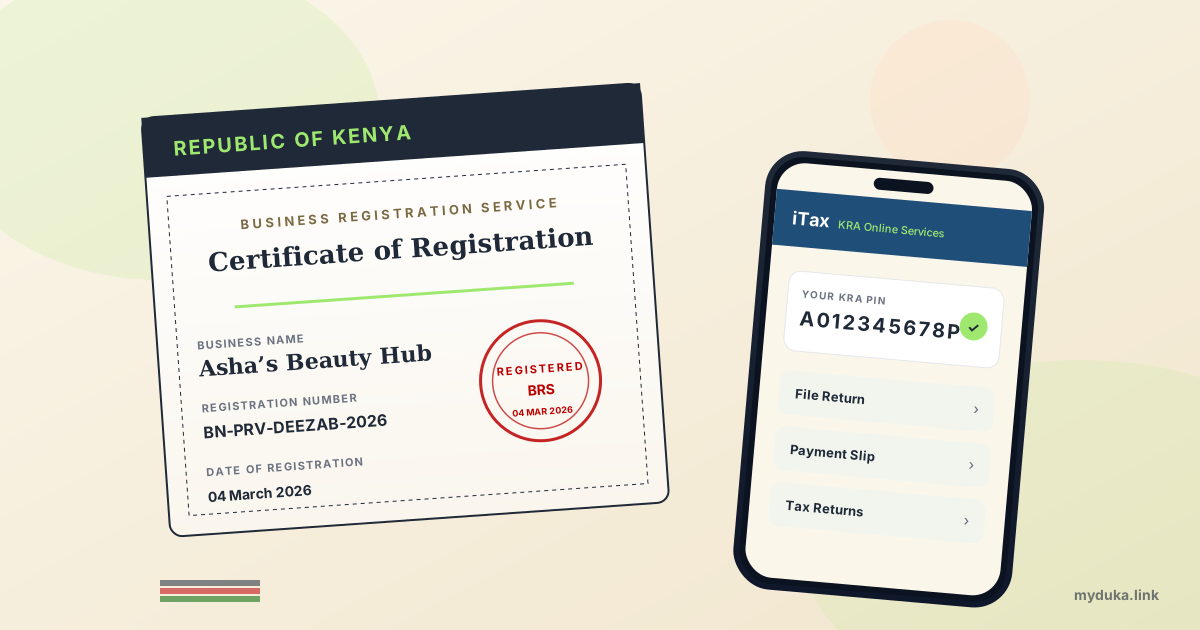
- Receive the certificate. Within 1 to 3 working days for sole prop, longer for Ltd, BRS emails you a digital certificate (a PDF with a QR code). That QR code is the only proof you need; you don't need a physical printout.
If your name is rejected, the system tells you why. Tweak it and resubmit; you don't have to start the application over.
Step 3: Get a KRA PIN (free, same day)
You need a KRA PIN before you can register on most payment gateways or open a Buy Goods Till in the business name. If you already have a personal KRA PIN from your salary or your last job, that's enough for sole prop trading. You can use the same PIN.
If you don't have one, register on iTax. It's free. The flow:
- Go to iTax, click "New PIN Registration."
- Pick "Individual" if you're a sole prop, "Non-Individual" if you registered a limited company.
- Fill the form. Use the same name as your ID. Pick the right tax obligations: at minimum, "Income Tax — Resident Individual" and, if you'll cross KSh 1 million in turnover, "Turnover Tax." You can always add VAT later.
- Submit. The PIN certificate is emailed to you, usually within minutes.
If your details don't match KRA's records (a misspelling on your ID record, a wrong DOB), iTax will refuse to issue the PIN. Visit any Huduma Centre with your ID and ask them to fix the underlying record. After that, the PIN issues immediately.
For the actual filing side of life after you have the PIN, see our companion piece on KRA tax for online businesses.
Step 4: County Single Business Permit (when it actually applies)
Every county requires businesses operating within its boundaries to hold a Single Business Permit. The fee depends on your county and your business size band, ranging from a few thousand shillings for a micro-business up to KSh 30,000+ for larger operations. Nairobi, Mombasa, and Kiambu enforce more aggressively than smaller counties.
The honest truth about online sellers: enforcement on home-based, single-person operations is uneven. If you're packing parcels in your bedroom in Kasarani, no county officer is knocking. If you rent a small office or a stockroom, or you have employees, that's when the permit matters and inspectors actually visit.
Get the permit when you have a real physical location, when you start hiring, or when you want to win contracts that ask for it. Apply through your county's e-services portal. Most counties have one now; if yours doesn't, walk into the county revenue office with your BRS certificate, KRA PIN, and a description of your business.
Common mistakes that delay registration
Paying an "agent" KSh 5,000 to "fast-track" your BRS application. There is no fast-track lane. The agent submits the same form on the same portal. Pay the official fee on eCitizen, save the agent fee for stock.
Picking a name without checking it first. If your name shares a single common word with an existing business in a related category, BRS may reject it. Search before you submit.
Not verifying your eCitizen email. The certificate goes to that address. If the email bounces, you'll have to call eCitizen support and re-trigger delivery, which adds days.
Registering with the wrong address. You can update it later, but couriers and KRA correspondence go to whatever address is on the certificate. Use one you actually check.
Skipping the KRA tax obligations during PIN registration. You can update later, but missing "Turnover Tax" or "Income Tax" means your PIN is functional but your filing reminders won't fire. Pick them at registration.
FAQ
How long does the whole process take?
Sole proprietorship: name reservation 1 to 3 working days, application 1 to 3 working days after that. Total 2 to 6 working days. Limited company adds another 3 to 7 working days for the company registration. KRA PIN is same-day if your ID details are clean. Plan for a week, end-to-end, for a sole prop with a KRA PIN.
Can I register a business if I'm under 18?
No. BRS requires the applicant to be 18 or older. If you're under 18, a parent or guardian can register on your behalf and add you as the trader once you turn 18.
Can I run multiple businesses under one PIN?
Yes, as a sole proprietor. One KRA PIN covers all your sole-prop trade names. You file one return that aggregates all your trading income. A limited company is a separate legal entity and gets its own PIN.
Do I need an office address?
You need a postal address (which can be a personal P.O. Box) and a physical address (which can be your residence, with the landlord's understanding). For an online sole prop you don't need a commercial office. A limited company needs a registered office address that BRS will publish in the public registry.
What if I want to change my business name later?
You can change a sole-prop trade name through BRS by filing a "change of particulars" form on eCitizen and paying the official fee. The new name has to clear a name search like a fresh application. Your KRA PIN stays the same.
Do I need a business bank account?
Not legally for a sole prop, but yes practically. Most Kenyan banks will open a business account once you show them your BRS certificate and KRA PIN. Equity, KCB, and Co-op all support business accounts that link to an M-Pesa Buy Goods Till in the business name. Don't run a serious shop on your personal M-Pesa.
Your next step
Open eCitizen right now, do a name search on three names you like, and reserve the one that clears. That's the only step that has to happen first. Everything else (KRA PIN, payment gateway, shop platform like MyDuka) plugs in once your BRS certificate is in your inbox. While you wait for the certificate email, read our complete guide to starting an online business in Kenya so you have the rest of the plan ready.