You've been telling yourself you'll "sort out the tax thing later." Sales are going well, you're shipping orders, and the KRA part feels like a problem for next year's you. Then somebody mentions monthly filing penalties and your stomach turns. This piece is the calm explainer of what KRA actually expects from a Kenyan online seller in 2026, what each tax does, and how to file each month without paying an accountant for things you can do yourself.
If you haven't yet registered your business or got a KRA PIN, start with our companion piece on how to register your business with KRA. The tax rules below assume you're already registered. For the wider business setup, see the complete guide to starting an online business in Kenya.
Why you have to file even if you barely earned anything
The day you got a KRA PIN, KRA created an obligation file for you. Each year (and for some taxes, each month), KRA expects a return showing what you earned. If you didn't earn anything, you file a "nil return." Skipping the filing entirely is what triggers penalties, not earning too little.
The minimum penalty for a missed individual annual return is KSh 2,000 a year. Miss three years and you owe KSh 6,000 plus interest, even if you literally earned nothing. For Turnover Tax and VAT, monthly missed filings stack up faster: KSh 1,000 to 10,000 per missed monthly filing depending on the tax. The cost of compliance is filing one form a month for free. The cost of skipping is real money.
Turnover Tax — what most online sellers actually pay
Turnover Tax (TOT) is the tax regime for small businesses. As of 2026, it applies to businesses whose annual gross turnover falls roughly between KSh 1 million and KSh 25 million. The rate is a flat 3% of gross monthly sales, filed and paid monthly via iTax. Verify the current band on kra.go.ke before filing, because the threshold has moved twice in recent years.
Some key points:
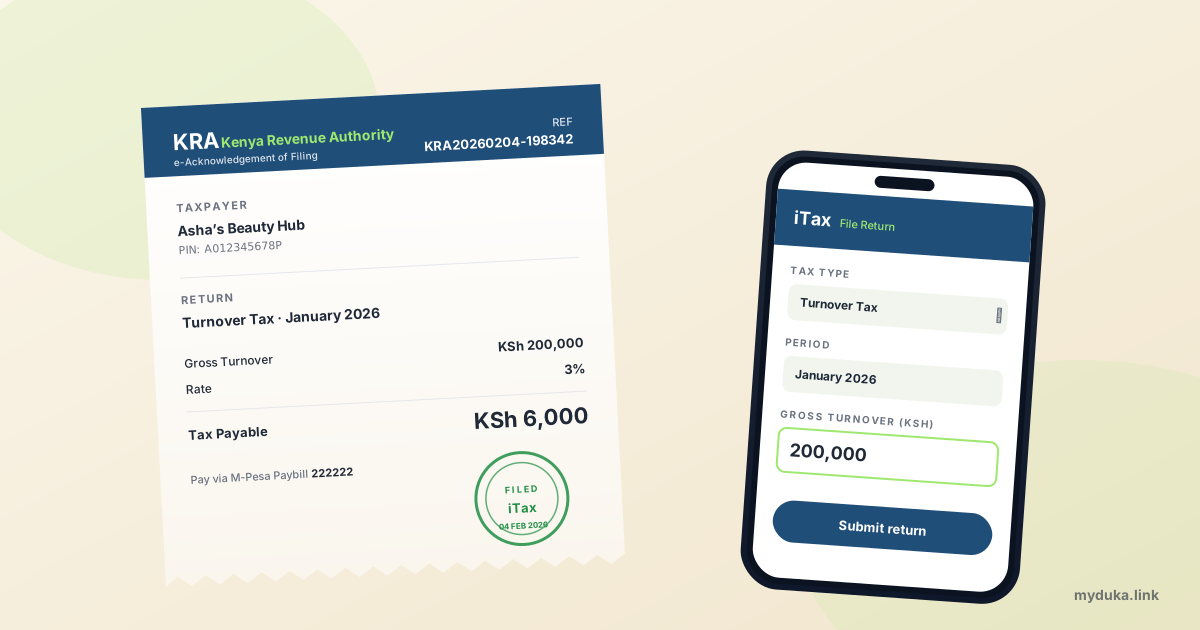
- It's on gross sales, not profit. If you sold KSh 200,000 in a month, you owe KSh 6,000 in TOT regardless of how much it cost you to acquire the stock.
- It's monthly. Due by the 20th of the following month. Sales for January are due by 20 February.
- Below the lower threshold, you may be exempt from TOT itself but still need to file an annual income tax return showing your low turnover.
- You can voluntarily opt out of TOT and pay regular individual income tax instead, which can be cheaper if your margins are very thin (the 3% on gross can exceed your actual profit). Most sellers don't bother, because TOT is simpler.
VAT — when (and only when) you must register
VAT (Value Added Tax) is a 16% tax on most goods and services. The rule for online sellers: you must register for VAT once your annual taxable turnover crosses KSh 5 million. Below that, you can register voluntarily, but most small sellers shouldn't.
Voluntary VAT registration is usually a bad deal for small B2C shops because:
- You have to charge 16% on top of every product price, making you 16% more expensive than your unregistered competitors.
- You file monthly VAT returns whether or not you traded.
- The reclaim on input VAT (what you paid your suppliers) is typically smaller than the output VAT you collect, so you remit the difference.
Voluntary registration only makes sense if your customers are mostly other businesses (B2B) that can reclaim the VAT, or if your suppliers charge you a lot of VAT and you want to claim it back.
Once you cross KSh 5M annual turnover, registration is compulsory. KRA will eventually catch up with anyone over the threshold who isn't registered, and the penalty is steep: 5% of unpaid VAT plus interest, going back to when you should have registered.
eTIMS — KRA's invoice system
If you register for VAT, you must also issue tax invoices through eTIMS, KRA's electronic Tax Invoice Management System. Every sale you make is invoiced through the eTIMS portal or via an integrated tax register, and the invoice data is transmitted to KRA in near real-time. Most shop platforms in Kenya now offer eTIMS integration so the invoices fire automatically at checkout.
eTIMS is also being rolled out to non-VAT-registered businesses for income-tax purposes, so even if you're under the VAT threshold, you may be expected to issue eTIMS invoices for B2B transactions. Watch for KRA notices.
Annual Individual Income Tax
If you're a sole proprietor, your business income is your personal income. You file an annual individual return on iTax, due by 30 June each year for the prior calendar year. You declare:
- Your business income (gross sales minus allowable expenses).
- Any salaried employment income (PAYE already deducted).
- Other income (rental, dividends, etc.).
If you've been paying TOT all year, the monthly TOT payments don't count against your individual income tax — they're a separate regime. You don't double-count, you just pick one regime per income source and stick with it.
If you registered a limited company, the company files its own corporation tax return (currently 30% of taxable profits), and you separately file your individual return for whatever salary or dividends you took out.
Real penalties, in real numbers
The most common penalties Kenyan sellers run into:
- Late annual return: KSh 2,000 minimum for individuals, 5% of tax due (or KSh 20,000, whichever is higher) for companies.
- Late TOT filing: KSh 1,000 per month or 5% of tax due, whichever is higher.
- Late VAT filing: KSh 10,000 minimum or 5% of tax due, whichever is higher.
- Late payment interest: 1% per month on unpaid amounts, compounded.
- Failure to register for VAT when above the threshold: 5% of tax that should have been charged, plus interest, plus a separate penalty for non-registration.
None of these are designed to be ruinous if you catch up promptly. The compounding starts to bite when you ignore them for two or three years.
How to actually file (the practical bit)
File your monthly TOT return
- Log into iTax with your PIN and password.
- Click "Returns" → "File Return."
- Select "Turnover Tax" from the tax type dropdown.
- Pick the relevant return period (the month you're filing for).
- Enter your gross turnover for that month. iTax calculates the 3% automatically.
- Submit. iTax generates a payment slip and an e-acknowledgement.
- Pay via M-Pesa Paybill 222222 (KRA's account number is the e-slip number) or via your bank.
Total time: 10 to 15 minutes once you know the flow. Set a recurring calendar reminder for the 18th of every month so you file by the 20th deadline.
File your annual individual return
Same iTax flow, picking "Income Tax — Resident Individual" instead. You'll see a long form. For most small online sellers, the relevant pages are the "Business Income" page (where you enter gross sales, expenses, and net profit) and the "Tax Computation" page (auto-calculated).
Keep simple records all year — a Google Sheet with a row per sale showing date, customer, amount, and a row per expense (stock, packaging, courier, M-Pesa fees, ads). At year-end, you'll just sum the columns.
The minimum bookkeeping you need
For TOT, you need to be able to prove your monthly gross turnover. KRA can audit you up to 5 years back. The minimum:
- A Google Sheet with one row per sale: date, customer name (or just a phone number), product, gross amount.
- A separate sheet for expenses: stock purchases (with supplier receipts), courier fees (with courier invoices), M-Pesa transaction fees (downloadable from your Till statement).
- Monthly bank/M-Pesa statements downloaded to PDF and saved per month.
If you do KSh 200,000+ a month consistently, hire a small accountant for KSh 3,000 to 5,000 a month to do the filing for you. Below that, doing it yourself is realistic.
FAQ
Do I have to pay tax on my online shop income?
Yes. Once you have a KRA PIN, you have a filing obligation. The two main regimes for small online sellers are Turnover Tax (3% of gross sales between KSh 1M and KSh 25M annually) and VAT (compulsory above KSh 5M annual taxable turnover). Below the TOT band, you may be exempt from TOT but still need to file an annual return.
What if I earn under KSh 1 million a year?
You may be exempt from Turnover Tax, but you still need to file an annual individual income tax return on iTax showing your actual income. Filing a "nil" or low-income return costs nothing and avoids the KSh 2,000 missed-return penalty.
Is my M-Pesa income visible to KRA?
Yes. KRA has data-sharing arrangements with Safaricom and the major banks. They can see your Till and Paybill turnover. Don't assume your sales are invisible just because no one is auditing you yet. KRA's compliance teams have started flagging high-volume Tills whose owners have under-declared income.
Should I register for VAT voluntarily?
Usually no, if your customers are mostly individual consumers. Voluntary VAT registration makes you 16% more expensive without giving you anything back. Register only when you cross KSh 5M annual turnover (then it's compulsory) or when most of your customers are VAT-registered businesses who can reclaim the VAT.
Can I claim my home internet, phone, and rent as expenses?
Partially. If you genuinely use them for business, you can claim a reasonable percentage. KRA's rule of thumb is 30 to 50% for a home-based business if you can justify it. Keep the bills as evidence. Don't claim 100% of your home rent if your business takes one corner of the living room.
Do I need to issue invoices on every sale?
For B2C sales below the eTIMS threshold, no formal tax invoice is required, but a simple receipt (M-Pesa SMS works as proof of sale) is enough. Once you're on eTIMS or VAT, every sale needs an eTIMS-compliant invoice. Most shop platforms automate this.
What happens if I haven't filed for years?
File now. KRA has periodic amnesty programmes that waive penalties for sellers who voluntarily come forward. Even outside an amnesty, the penalty for filing late is much smaller than the penalty for KRA finding you first. Catch up on iTax, pay any tax due, and resume monthly filing.
Your next step
Log into iTax tonight. Check your filing history. If you've missed any returns, file them this week, even nil ones. Set a recurring reminder for the 18th of every month for TOT. Open a Google Sheet today with two columns (sales and expenses) and start logging. By next month you'll have the data ready and the filing will take 10 minutes. For the rest of the business setup, the pillar guide covers everything around it.