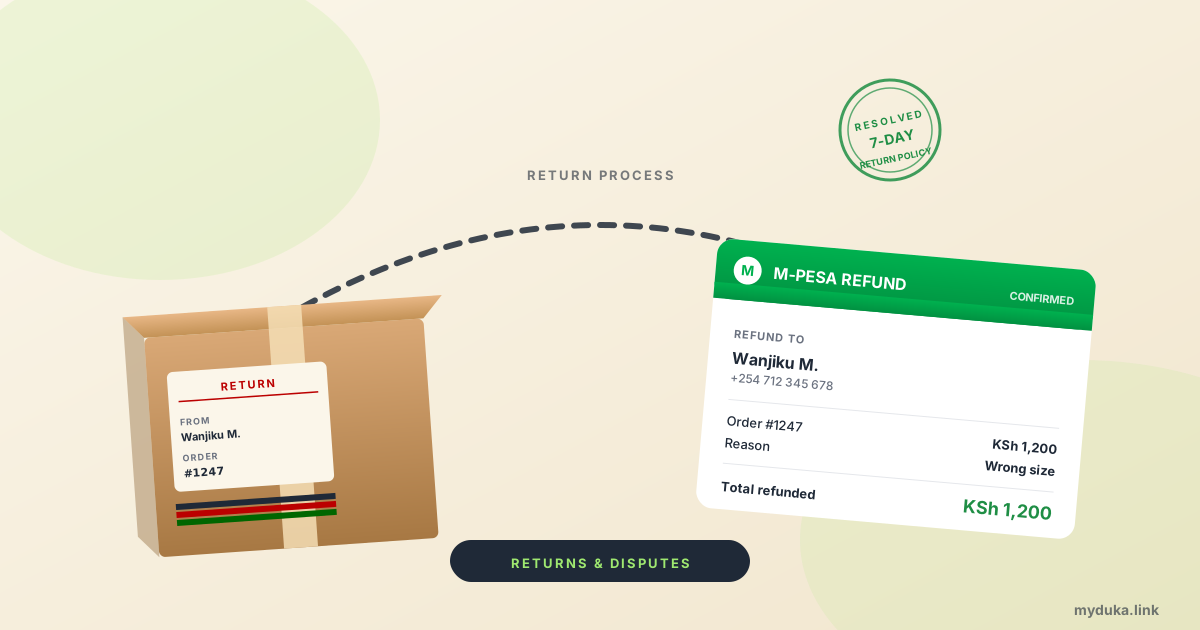
Every Kenyan online shop reaches the day a customer wants to return something. The argan oil arrived, the customer changed their mind. The dress doesn't fit. The phone case is the wrong colour. The package arrived wet because Sendy left it on a doorstep in the rain. How you handle these moments decides whether the customer becomes a one-time buyer with a bad story or a repeat customer with a good one.
This guide walks through what the law actually requires, the returns policy template that works for most Kenyan small shops, and how to handle the four kinds of disputes that come up. If you're building the wider picture, our complete guide to starting an online business in Kenya covers payments, shipping, and customer acquisition.
The legal floor: Consumer Protection Act 2012
The Consumer Protection Act 2012 is the Kenyan law that governs returns, refunds, and consumer disputes. The headlines every online seller should know:
- Goods must match the description. If you advertised "100% pure argan oil" and shipped a synthetic blend, the customer is entitled to a refund regardless of any "no returns" policy.
- Goods must be of merchantable quality. Defects, damage during shipping, missing parts: refundable.
- Goods must be fit for purpose. If you sold a "waterproof phone case" and water destroyed the phone, that's a returnable failure of purpose.
- Misleading representations are unlawful. Fake reviews, photoshopped product images, false country-of-origin claims — all actionable under the Act.
- You cannot waive consumer rights with a "no returns" policy. A clause saying "all sales final" doesn't override the law for defective or misrepresented goods.
What the Act does let you do:
- Refuse returns for buyer's remorse on products that arrived as described.
- Set reasonable conditions (return within 7 days, original packaging, undamaged).
- Charge a restocking fee on opened returnable items, if disclosed upfront.
- Refuse returns on certain categories (perishables, custom/personalised goods, intimate items) for hygiene or practicality reasons, again if disclosed upfront.
The Competition Authority of Kenya (CAK) handles consumer protection complaints. Real cases against small shops are rare but real. The bigger risk is Twitter/X posts and Instagram complaints damaging your reputation. Get the policy right, follow it consistently, and most disputes resolve before they reach either platform.
A returns policy template you can copy
Paste this on your shop's "Returns & Refunds" page (or in your FAQ widget — see our help article on the FAQ widget). Customise the bracketed parts.
Returns and refunds at [Your Shop Name]We accept returns within 7 days of delivery for the following reasons:
- The item arrived damaged or defective.
- The item doesn't match what we advertised.
- You received the wrong item.
- The item is the wrong size (clothing/footwear only, with original tags).
To return: WhatsApp us at [your number] with your order number and a photo of the item. We'll confirm the return and arrange pickup or give you a return shipping address.
For damaged or wrong items, we cover return shipping. For wrong-size returns, the customer covers return shipping. Refund issued within 48 hours of the item arriving in good condition, by M-Pesa to the number that paid.
Items we don't accept returns on:
- Perishables (food, fresh produce).
- Intimate items (underwear, swimwear, earrings).
- Custom or personalised items made to your order.
- Items used or returned without original packaging.
For damaged or defective items in any of these categories, we'll always replace or refund. The exclusions above apply only to buyer's remorse.
Three things this template does well: it lists what's accepted (so customers know they're protected), it lists what's not (so they don't ask), and it tells them exactly how to start the return (one WhatsApp message).
Restocking fees: when they're fair, when they're not
A restocking fee is a percentage you keep when accepting a return — say 15% of the order — to cover the time, repackaging, and second courier leg.
Restocking fees are fair when:
- Disclosed upfront, in your returns policy, before the customer ordered.
- The return is buyer's remorse, not damage or your error.
- The amount reflects actual costs (10–20% is typical; 30%+ looks predatory).
Restocking fees are not fair (and likely unenforceable under the Act) when:
- The item arrived damaged or defective.
- You sent the wrong item or wrong size.
- The customer wasn't told about the fee at order time.
Many small Kenyan shops skip restocking fees entirely because the operational complexity isn't worth the recovered margin on a few returns. If returns are under 5% of your orders, drop the fee and accept the cost as a customer-acquisition expense.
Handling M-Pesa reversal disputes
Safaricom allows M-Pesa transaction reversals through their dispute process. The customer initiates a reversal request through the M-Pesa app or by calling 234. If approved, the funds are reversed within 24 hours. As a seller, you find out either:
- An SMS notification from Safaricom that a reversal is being investigated.
- A reversal already executed, and your Till statement shows the deduction.
The legitimate reasons a reversal is granted:
- The customer paid the wrong amount or to the wrong Till.
- The customer paid but the order was never fulfilled.
- The seller misrepresented the goods materially.
The fraud reasons (Safaricom usually catches but sometimes doesn't):
- The customer paid, received the goods, then claimed non-receipt.
- The customer paid, claimed the goods were defective without evidence.
How to protect yourself:
1. Always send a confirmation message after delivery. "Hi [name], your order arrived at [time]. Thanks for shopping with us!" Save the customer's reply confirming receipt. This is your evidence.
2. Use a courier with proof of delivery. G4S, Sendy, and Wells Fargo all generate delivery confirmation. The receipt is your evidence the customer received the item.
3. Photograph the parcel before dispatch. A photo of the packed parcel with the customer's name and address visible, taken at your end before the courier collected, plus the courier's pickup acknowledgement, defends against "I didn't receive anything."
4. Reply to Safaricom's investigation message promptly. They give you 5 working days to respond. Send everything — order screenshots, courier tracking, photos, the customer's confirmation message. Most legitimate disputes resolve in your favour with this evidence.
If a reversal goes through and you have evidence the goods were delivered as described, you can file a counter-claim with Safaricom Business support. Most counter-claims resolve within 14 days. You may also have legal recourse via small claims court for amounts under KSh 1 million, but most shops never bother — the time cost outweighs the recovery.
Damaged goods vs buyer's remorse
The most common disputed return: a customer says "this is damaged" when the item is actually fine and they've changed their mind. The shorthand for both sides:
Genuinely damaged signs:
- Photo evidence of cracks, tears, leaks, missing parts.
- Photo of the parcel with visible damage from delivery.
- Damage matches a known shipping risk (fragile items, liquid leakage).
- Customer reports the issue within 24 hours of delivery.
Buyer's remorse signs:
- Photos vague, blurred, or refused.
- Issue reported 5+ days after delivery (gave them time to use, regret, return).
- "Damage" descriptions inconsistent with the product (a hair oil that "smells funny" isn't damage).
- Customer asks for a refund without offering to return the item.
For damaged goods: refund or replace, every time. Don't argue, don't negotiate. The customer is upset and the cost of replacement is small compared to the brand damage of a public complaint. Save your fight for the obvious cases.
For buyer's remorse: politely refer to your returns policy. "Our policy is 7-day returns for damage or wrong items. I don't see damage from your photos, and the item matches our description. Happy to help if there's something specific you'd like me to look at — otherwise we'd love to credit a future order for you." Most customers stand down at this point.
The "lost in transit" debate
The customer says the parcel never arrived. The courier says it was delivered. Who's right?
If the courier has proof of delivery (signature, photo of doorstep, receipt of receipt at destination branch), the shop is generally not liable. The customer's recourse is with the courier, not you. Send them the courier's proof and the courier's customer service number.
If the courier has no proof — they can't say where the parcel went — the shop is liable. You either replace the parcel (cheaper for small-value items) or claim against the courier's lost-parcel insurance (worth it for KSh 5,000+ items, takes 2 to 4 weeks).
This is why you should never ship high-value items by an uninsured courier. For anything over KSh 10,000, use a courier with declared-value insurance. The 1% premium is cheaper than the occasional lost parcel.
Common mistakes
"All sales final." Unenforceable for damaged or misrepresented goods, and customers know it. Replace with the real returns policy template above.
Refunding everyone to avoid the fight. You'll be exploited within weeks. Have a clear policy and stick to it. The customer you politely turn away (because they want a refund without grounds) is worth losing for the precedent it sets.
Refunding by sending cash to "any account." Always refund to the M-Pesa number that paid. This avoids fraud (someone claiming to be the customer with a different number) and keeps your bookkeeping clean.
Not photographing parcels before dispatch. Without that photo, you have no defence against "the parcel was empty when it arrived" or "the wrong item was sent." 30 seconds at the courier handover, photo of the boxed item with the customer's address sticker visible.
Letting complaints fester. The complaint that simmered for two weeks before exploding on Twitter could have been resolved in 30 minutes on day one. Acknowledge within an hour, resolve within 24, follow up within a week. (Our WhatsApp customer service guide has the 3-message script.)
Going nuclear on customers who post complaints publicly. Reply once, professionally, in public. Move the resolution to DM. Never argue line-by-line on a public post — every reply re-amplifies the complaint to new viewers.
FAQ
Am I legally required to accept returns in Kenya?
For damaged, defective, or misrepresented goods: yes, under the Consumer Protection Act 2012. For buyer's remorse on goods that arrived as described: no, you can refuse, provided your no-returns policy was disclosed before the order. A "no returns" clause does not override the legal protection for damaged or misrepresented goods.
How long should my returns window be?
Seven days from delivery is the standard for most Kenyan small shops. Long enough that the customer has time to inspect and try the item; short enough that you're not still dealing with returns from last month. Some categories (electronics) extend to 14 days; perishables and intimate items typically have no returns at all (only replacement for damage).
Should I charge a restocking fee?
Optional. Most small shops with under 5% return rates skip it because the operational hassle isn't worth the margin. If you do charge one, 10–20% is typical, must be disclosed upfront, and only applies to buyer's remorse (never to damaged or wrong-item returns).
What do I do if a customer initiates an M-Pesa reversal?
Reply to Safaricom's investigation message within 5 working days with evidence: order screenshots, courier tracking with proof of delivery, photos of the parcel before dispatch, and any confirmation message from the customer that the goods arrived. Most legitimate disputes resolve in your favour with this evidence. If a reversal goes through unfairly, file a counter-claim with Safaricom Business support.
How do I handle a customer who says the parcel never arrived?
Check the courier's tracking. If the courier has proof of delivery (signature, photo, branch receipt), share it with the customer and direct them to the courier's complaint line. If the courier has no proof, replace the parcel and claim against the courier's insurance for items over KSh 10,000. Always insure high-value parcels.
Can a customer leave a bad review if I refused a refund?
Yes, customers can post whatever they want. Reply once, calmly, in public. State your policy briefly without arguing. Offer to take it to DM. Don't reply line-by-line — every reply amplifies the complaint to new viewers. One firm, fair public reply followed by silence usually settles the matter.
Your next step
Tonight: copy the returns policy template above, customise it for your shop, paste it on your "Returns & Refunds" page or FAQ. Add the order-confirmation-after-delivery message to your dispatch routine. Photograph the next parcel you pack. These three small habits cover 90% of the disputes a Kenyan online shop hits in its first year. The rest of the playbook is in the pillar guide on starting an online business in Kenya.