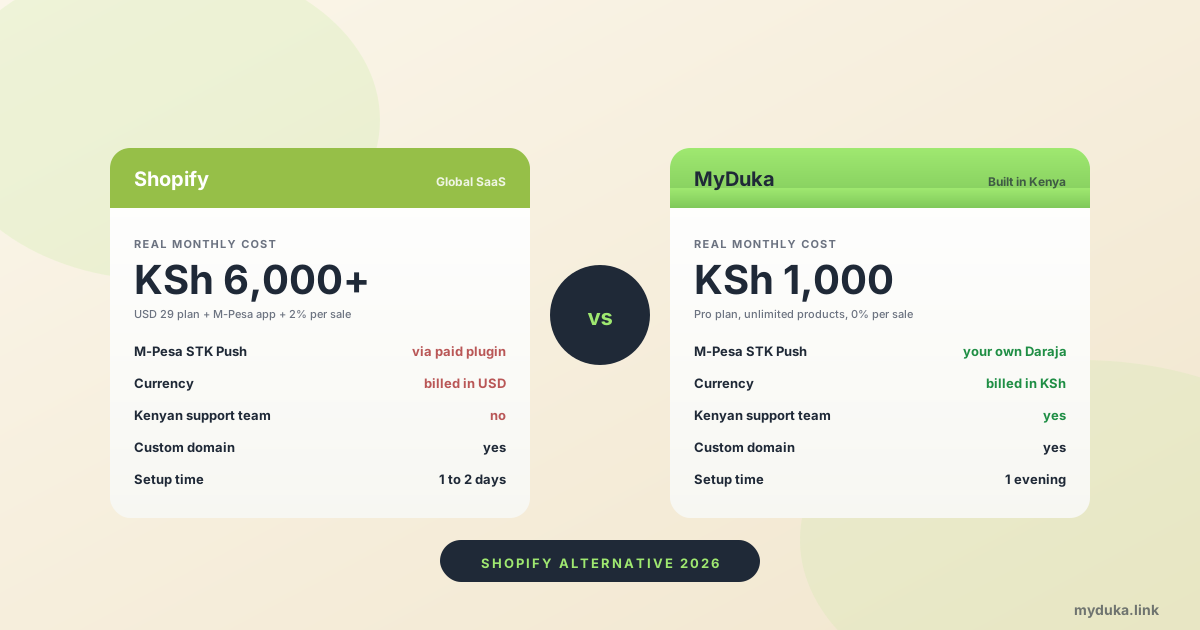
You've watched a Shopify ad. You've checked the Shopify pricing page. You've done the maths in shillings, hit the M-Pesa app problem, and closed the tab. Then somebody told you to "just use WordPress" and you closed three more tabs. This is the article you actually wanted: an honest comparison of what's available to a Kenyan seller in 2026 who wants a real online shop without a Shopify-sized bill.
If you also need the wider picture — payments, registration, shipping — read our complete guide to starting an online business in Kenya. This piece focuses tightly on the platform decision.
What Shopify actually costs in Kenya
Shopify's headline price is USD 29 a month for the Basic plan, which sounds reasonable until you do the rest of the maths in real Kenyan reality:
- Plan fee: USD 29 a month, roughly KSh 4,000.
- M-Pesa app: Shopify doesn't natively support M-Pesa. You install a third-party app (Bunifu, Lipa-M-Pesa-Kenya, or similar) which costs USD 10 to 25 a month, roughly KSh 1,400 to 3,500.
- Theme: Free themes exist, but most sellers buy a paid one. Roughly USD 200 to 350 one-off, KSh 28,000 to 50,000.
- Transaction fees: Shopify charges a 2% transaction fee per sale unless you use Shopify Payments (not available in Kenya). Stripe and PayPal each take their own cut on top.
- Domain: KSh 1,000 to 1,500 a year for a .ke or .com domain.
Realistic monthly cost in Kenya for a working Shopify shop: KSh 6,000 to 8,000, plus the 2% Shopify transaction fee on every sale. Shopify Lite, the cheap "buy button only" plan, was retired in 2022.
If you're doing KSh 500,000+ a month in revenue and you sell to a global audience that pays by Visa, Shopify is justifiable. If you're doing KSh 30,000 a month to Kenyan customers paying with M-Pesa, you're paying a lot for features you don't use.
The real alternatives in Kenya
Three categories of alternative are worth considering: Kenyan-built SaaS, self-hosted WordPress + WooCommerce, and Jumia. Each has different tradeoffs.
Kenyan-built SaaS (MyDuka and similar)
MyDuka is a Kenyan-built equivalent of Shopify. The free plan supports up to 10 products with a built-in subdomain (yourshop.myduka.link). The Pro plan is KSh 1,000 a month or KSh 10,000 a year, and unlocks unlimited products, a custom domain, themes, and coupons.
The M-Pesa story is the differentiator. MyDuka supports STK Push two ways: you connect your own Daraja API keys (free, you handle the Safaricom application yourself, transactions go straight to your Till), or you use PayHero as a one-click alternative (small per-transaction fee, faster onboarding). Either path is built into the dashboard. We covered this in detail in the M-Pesa Daraja API integration piece.
What you also get: product catalog, cart, checkout, orders dashboard, multiple themes, customer database, "Order via WhatsApp" button on every product, shipping zones, and basic analytics. Stripe, PayPal, Pesapal, and cash on delivery are also supported alongside M-Pesa.
What you don't get: built-in courier integration (no auto-dispatch to G4S or Sendy yet — fulfilment is manual), advanced loyalty programs, or a vast app marketplace.
WordPress + WooCommerce (self-hosted)
The classic open-source stack. WordPress is free, WooCommerce is free, and there are M-Pesa plugins for KSh 5,000 to 15,000 one-off or rented monthly.
Real costs: KSh 1,500 to 5,000 a month for hosting (Hostpinnacle, Truehost, or DigitalOcean), KSh 1,200 a year for a domain, plus a one-off KSh 5,000 to 30,000 to a developer to set it up properly. Themes range from free to KSh 8,000 one-off. Plugin maintenance is on you.
Pros: total control, no per-sale commission, you own the data, infinite extensibility through plugins.
Cons: updates and security patches are your problem; if something breaks at 11pm, you call the developer; performance tuning is required at scale; you'll spend more weekends than you expected on maintenance.
Pick WordPress + WooCommerce if you have a developer relationship you trust and you want to own everything. Skip if you'd rather focus on selling.
Jumia (as a seller)
Jumia isn't a shop platform, it's a marketplace where you list as a vendor. There's no monthly fee, but Jumia takes a category commission (typically 12 to 15%) plus payment processing on every sale. They handle payment, sometimes fulfilment (Jumia Logistics), and customer support.
Pros: Jumia has organic traffic. If your category is popular on Jumia, you get sales without marketing.
Cons: Jumia owns the customer relationship — you don't get the buyer's phone number or email for follow-up. You can't build a brand. You're at the mercy of Jumia's category algorithms and seller policies.
Use Jumia as a supplementary channel if your category fits, not as your only channel.
Side-by-side comparison
| Platform | Monthly cost (KSh) | M-Pesa STK Push | Customer data | Setup time | Best for |
|---|---|---|---|---|---|
| Shopify + M-Pesa app | 6,000 to 8,000 + 2% per sale | Via paid plugin | You own it | 1 to 2 days | International / global brands |
| MyDuka Free | 0 | Your own Daraja or PayHero | You own it | 1 evening | ≤ 10 products, just starting |
| MyDuka Pro | 1,000 | Your own Daraja or PayHero | You own it | 1 evening | Serious Kenyan sellers, unlimited products |
| WooCommerce | 1,500 to 5,000 (hosting) + setup | Via plugin | You own it | 1 to 2 weeks (with developer) | Sellers with a dev they trust |
| Jumia (marketplace) | 0 + 12 to 15% commission | Via Jumia checkout | Jumia owns it | 2 to 4 weeks (approval) | Categories with strong Jumia search traffic |
How to pick, in plain rules
You're starting from zero with under 10 products and want to test the water. MyDuka Free. Costs nothing, takes an evening, gets you a real shop URL with M-Pesa STK Push.
You have 10+ products and want a Kenyan-feel shop with a custom domain. MyDuka Pro at KSh 1,000 a month. Same cost as one Instagram ad day, gives you everything you need.
You sell internationally and most of your customers pay with Visa or PayPal. Shopify. Pay the global price for global checkout reach. Add an M-Pesa app for your Kenyan customers.
You have a developer who's already comfortable with WordPress. WooCommerce. You'll get the lowest long-run cost at the price of weekend maintenance.
You sell in a category Jumia is dominant in (electronics, fashion accessories). Add Jumia as a secondary channel alongside your own shop. Don't put your whole business there.
Switching from Shopify to a Kenyan platform
If you're already on Shopify and the bill is hurting, migration is straightforward:
- Export your products. Shopify lets you export the full catalog as CSV from Settings → Apps → Export.
- Export your customers. Same place. Keep the CSV — those phone numbers and emails are your hardest-earned asset.
- Set up the new platform. Import the products via the new platform's CSV import. MyDuka and most alternatives accept Shopify-format CSV with minor cleanup.
- Wire up M-Pesa. Plug your Daraja credentials or PayHero details into the new shop. Push a test transaction.
- Set up redirects. If your old Shopify URLs were public, set up 301 redirects from the old URLs to the new ones to preserve any SEO equity.
- Cancel Shopify. Don't cancel before you've confirmed the new shop is live and taking orders for at least a week.
The whole migration takes 2 to 5 days for a small shop, longer if you have a thousand SKUs.
FAQ
Is MyDuka really free, or is there a catch?
The free tier is genuinely free, capped at 10 products and the classic theme. There's no time-limited trial, no credit card requirement, and no commission per sale. The Pro plan at KSh 1,000 a month unlocks unlimited products and additional features. Both tiers support M-Pesa via your own Daraja credentials or PayHero.
Can I use my own domain on a Kenyan shop platform?
Yes. MyDuka Pro supports custom domains (you point your .co.ke or .com to the platform and it serves your shop from your domain). Free tiers usually use a subdomain like yourshop.myduka.link. Most other Kenyan platforms have similar models.
Will my Shopify customers automatically transfer?
Customer accounts don't transfer because passwords are hashed and can't be moved. Customer phone numbers and emails do transfer via CSV export. Send a "we've moved" email to your customer list with the new shop URL and a one-time discount code.
Is WooCommerce really cheaper than MyDuka over time?
Math depends on your time. WooCommerce hosting at KSh 1,500 to 3,000 a month is cheaper than MyDuka Pro's KSh 1,000 a month is wrong — they're roughly equivalent in monthly cash. But WooCommerce demands developer time for updates, security patches, and breakage. If you don't already have a developer on speed dial, MyDuka Pro is cheaper in real total cost.
Does Shopify work for Kenyan customers if I'm paying USD?
Yes, the shop displays in shillings if you set the currency to KES. The customer pays in shillings via the M-Pesa plugin or card via Stripe/PayPal. The merchant pays Shopify in USD, so your monthly bill fluctuates with the exchange rate.
What about Wix, Squarespace, or BigCommerce?
None of them have native M-Pesa support, all of them charge in USD, and none of them have a Kenyan support team. They're more expensive than Shopify with weaker M-Pesa stories. Skip.
Your next step
Open a free MyDuka account this evening. List your three best-selling products. Connect your M-Pesa via Daraja sandbox or PayHero. Run one test order. If it feels right, upgrade to Pro for a custom domain and unlimited products. If it doesn't, you've spent zero and you know more than you did. Read our pillar guide for the rest of the setup, and the WhatsApp Business + a shop link piece for how to combine your shop URL with WhatsApp status traffic.