You opened the shop. You uploaded the products. You shared the link on your status, in your bio, in three different WhatsApp groups, and to your one friend who already buys from you anyway. A week passes. Two weeks pass. The traffic is real, but the sales are quiet. Someone tells you to "just boost a post." You spend KSh 500. Nothing. You spend KSh 2,000. A like. Maybe a DM that ghosts you. You start to wonder if ads even work in Kenya.
They do. But there's an order you have to do things in, and most sellers — and most "social media manager" packages — skip the first half and charge for the second half. This guide walks you through every stage, in the order you should actually do it. By the end you'll know exactly which channel to spend on this week, what to ignore, and how to know when you're ready to scale.
1. The three phases — and what to expect from each
Online shops don't go from launch to sales overnight. They move through three predictable stages. Knowing which one you're in tells you where to put your time, where to spend your money, and what success looks like this month versus six months from now.
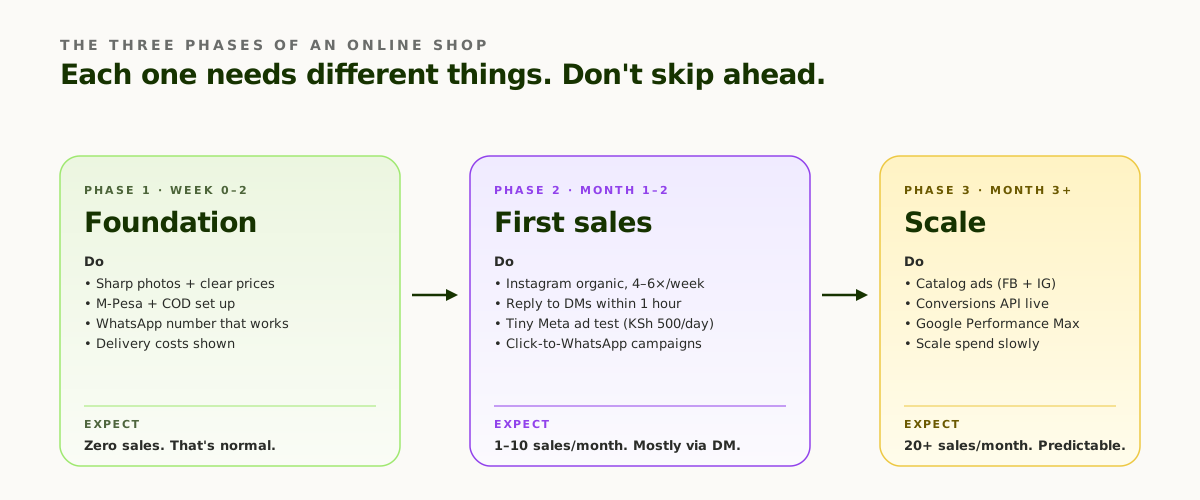
Phase 1 — Foundation. The first two weeks. You're setting up the shop so a stranger would actually trust it: sharp photos, prices in KSh, M-Pesa wired up, a working WhatsApp number, delivery costs in plain sight. Zero sales is normal here. You're building the runway.
Phase 2 — First sales. Month 1 and 2. You start posting on Instagram four to six times a week, reply to every DM within an hour, and run small ad tests at KSh 500/day. Most of your sales will come through WhatsApp, not the website checkout — that's fine. You're learning what your buyers actually want.
Phase 3 — Scale. Month 3 onwards. You can name your three best-selling products and the price you can afford to pay for a new customer. Now is when you turn on Catalog ads, set up the Conversions API for accurate attribution, and start exploring Google Performance Max. Expect 20+ sales per month with a predictable cost per sale.
How do you know which phase you're in? Open your own shop on a friend's phone (not yours). Pretend you've never seen it. Find a product, find the price, find how to pay, find how to contact the seller. Time it. If any step takes more than 10 seconds, you're still in Phase 1, no matter how long the shop has been live.
2. Build a shop that's worth visiting
Before any ad runs, every product page must answer three buyer questions in under five seconds: What is it? How much? How do I get it? If any of these is unclear, fix it first. Five things every Kenyan shop needs:
1. Sharp product photos — at least three per product. One main shot on a clean background, two from different angles, one in use if possible. Bright, in focus, taken on a phone in daylight is fine. Avoid screenshots from suppliers — they look like a reseller and kill trust instantly. There's more on shooting good photos in our smartphone product photography guide.
2. Honest, specific descriptions. Two short paragraphs is enough. What it does, who it's for, what's in the box. Add specs as a bullet list. No fake hype, no "trust me you'll love it" — buyers in Kenya are sharp, they spot it. The descriptions guide has templates you can paste in.
3. Prices shown clearly in KSh. Don't make buyers DM you to ask the price. If you sell at multiple prices (wholesale vs. retail), put the retail price on the site and offer the wholesale rate via WhatsApp. Hidden prices = bounced visits. If you're unsure what to charge, we wrote a whole guide on pricing products in Kenya.
4. M-Pesa as the first payment option. Set up M-Pesa Daraja in your dashboard (or use PayHero if you don't want to apply directly — full walk-through in our M-Pesa integration guide). Add Cash on Delivery if your product allows it. Card payments via Stripe are nice-to-have, but most Kenyan buyers will reach for M-Pesa first.
5. Working WhatsApp button + phone number. Every shop has a "WhatsApp the seller" affordance — make sure your number is correct and you actually reply. A working WhatsApp link is worth more than ten trust badges. The WhatsApp Business guide covers how to set up auto-replies for after-hours.
Free trust boosters that move sales:
- Add a physical address or Google Maps link in Shop → Contact → Map link. Even if you sell online only, a real address makes you feel like a real business.
- Show your delivery options and costs up front. Don't surprise buyers at checkout. The MyDuka.link checkout supports named delivery zones with explicit prices.
- Turn on customer reviews for every product. The first three reviews change a shop's conversion rate more than any redesign ever does. Ask buyers to leave one after delivery.
- Mobile-first everything. The overwhelming majority of Kenyan shop traffic is mobile. If a product page needs more than two thumb-scrolls to reach "Add to cart," it's too long.
3. SEO basics that bring buyers without ad spend
SEO doesn't replace ads — it sits underneath them. A well-optimised shop earns free traffic from Google for months, sometimes years, after the work is done. None of this requires technical skills.
Product titles that read like searches. Write titles the way someone in Kenya would type them into Google. "Apple AirPods Pro 2 (USB-C) — Nairobi delivery" beats "Premium Wireless Audio." Include brand, model, key spec, and (optionally) location.
Group products into clear categories. Sellers who organise products into four to ten clear categories rank better than sellers with a flat catalog. Use names buyers actually search: "Laptops," "Phone cases," not "New Arrivals."
Add a meta description per product. Two sentences that summarise the product plus a hook. This is what Google shows in search results — it decides whether someone clicks. Edit under each product's "SEO & sharing" section.
Submit your sitemap to Google. Your shop already publishes a sitemap at yourshop.myduka.link/sitemap.xml. Go to Google Search Console → Sitemaps → Add a new sitemap and paste it. Google will crawl your products within days instead of weeks.
Claim your Google Business Profile. Free, takes 15 minutes at google.com/business. Once verified, your shop shows up in Google Maps and the "knowledge panel" when someone searches your shop name. Photos, reviews, opening hours all live here.
The single highest-ROI free traffic move? Write one blog post a month answering a buying question. Examples: "How to pick a laptop for university in Kenya," "Refurbished vs. new phones — what's the catch?", "Best wireless earbuds under KSh 5,000." Each post earns Google traffic indefinitely. Use the built-in blog in Dashboard → Pages.
4. Facebook & Instagram — where to start
For most new Kenyan shops, Meta is the right place to start paid ads. The audience is on these apps every day, the auction is friendlier to small brands than Google Search, and the path from "saw the ad" to "sent M-Pesa" is shorter — especially with Click-to-WhatsApp.
The four-step Meta setup
Step 1: Connect the Pixel + Conversions API. In your MyDuka.link dashboard go to Shop → Meta ads. Paste your Pixel ID + your Conversions API access token (Meta Events Manager → Settings → Conversions API → Generate token). The Pixel tracks browser behavior, the Conversions API mirrors it server-side — together they survive iOS, Safari, and ad-blockers that eat browser-only data. Without both, you're flying half-blind.
Step 2: Submit your product catalog feed. Your shop auto-generates a Meta-ready catalog feed at yourshop.myduka.link/meta-feed.xml. Paste this URL into Meta Business Suite → Commerce Manager → Data sources → Scheduled feed. Set fetch to Daily. This unlocks Advantage+ Shopping ads, which automatically pick the right product to show each user.
Step 3: Run a Click-to-WhatsApp campaign first. It's the highest-converting format for the Kenyan market — buyers tap the ad and land in a WhatsApp chat with you, where you close the sale in DMs. Your dashboard generates the wa.me link with a pre-filled greeting. Paste it as the ad destination in Meta Ads Manager.
Step 4: Verify your domain. In Shop → Meta ads, paste the domain-verification code from Meta Business Settings → Brand Safety → Domains. The verification tag renders in your storefront automatically. Verified domains are required for accurate attribution under Apple's tracking rules.
Targeting that works in Kenya
- Location: Kenya only. If you only deliver to certain cities, list them — Nairobi, Mombasa, Kisumu, Eldoret, Nakuru — and exclude the rest.
- Age: 25–44 for most categories. 18–34 for fashion / cosmetics / accessories. 30–55 for home goods, baby and kids.
- Devices: Mobile only. Desktop traffic in Kenya is small and rarely shops at work.
- Languages: English + Swahili. Add both — it widens reach without diluting quality.
For more on Instagram specifically — captions, hashtags, Reels, and how to grow a Kenyan following from zero — see our Instagram marketing guide and the TikTok counterpart.
5. Google Ads — the right way
Google Ads is a high-intent auction. Buyers searching there already know what they want. It rewards shops with proof: conversion data, a product feed, trust signals. Don't start here. Start here when you've done Phases 1 and 2 and have data to feed it.
If you do reach the point where Google makes sense, three rules apply before you spend a shilling:
Rule 1: Conversion tracking must be set up first. Without it, Google has no idea what a "good click" looks like — it'll optimise for cheap clicks, not sales. Go to Google Ads → Tools → Conversions → New conversion action → Website → use the page-load method on your order-confirmation page. Your shop already loads the Google tag base, so the conversion fires automatically.
Rule 2: Lock targeting to Kenya only. In each campaign: Settings → Locations → choose Kenya. Then under Location options switch from "Presence or interest" to "Presence (people in your targeted locations)." This stops your budget from leaking on clicks outside Kenya.
Rule 3: Use Performance Max with a product feed — not plain Search. Plain Search ads are text-only and compete with Jumia, Avechi, and Phones Store Kenya for every click. Performance Max shows your actual product photos and prices in Google Shopping carousels. Submit your shop's feed at yourshop.myduka.link/merchant-feed.xml to Google Merchant Center → Products → Feeds → Scheduled fetch. Once approved, run Performance Max instead.
Useful negative-keyword starter pack
Whatever campaign type you run, add these as negative keywords (Broad match) to block clicks that won't buy:
free · used · second hand · refurbished · repair · cheap · jiji · olx · for sale by owner · how to · review · vs
Add categories of negatives that fit your shop: years (e.g. 2012, 2015) if you sell new gear, brand names of competitors, slang terms you don't sell.
6. Your weekly + monthly rhythm
The sellers who grow are the ones who do small, consistent things every week. Walk through this once a week. Total time: 30 minutes.
Every Monday — 15 minutes
- Reply to every WhatsApp + Instagram DM from the last 48 hours. Response speed is the single biggest conversion lever in Kenya.
- Add at least 2 new products OR refresh photos on 2 existing ones. A growing catalog signals an active shop.
- Check your active orders — anything pending more than 24 hours gets a personal follow-up.
Every Friday — 15 minutes
- Open your dashboard analytics — look at this week's top 5 pages. The pages that get the most visits but the fewest add-to-carts are your biggest leaks.
- If running Meta ads: open Events Manager and check the Pixel + CAPI are both green.
- If running Google Ads: open Search Terms and add negative keywords for anything that isn't buying intent. Ten minutes of negatives per week saves more budget than any other optimisation.
- Calculate this week's conversion rate (orders ÷ visits). Below 0.5%? Fix the shop before scaling ads. Above 1%? You're ready to spend more.
Once a month — 30 minutes
- Ask 3 customers for a review. Personally. A WhatsApp message to your last 3 happy buyers will get more reviews than any automated email.
- Write one blog post answering a buyer question. Free Google traffic compounds — the post you write today still earns visits 12 months from now.
- Review the last 30 days of ad spend vs. attributed sales. Decide: scale, hold, or pause. No emotional decisions.
FAQ
How much should I budget for ads in my first month? KSh 500/day on one Meta Click-to-WhatsApp campaign is enough to test. KSh 15,000/month is plenty if your shop is set up properly. Anything more than that without proof of conversions is gambling.
Should I "boost" my Instagram posts? Boosting a post is the lowest-quality version of Meta ads — it uses fewer targeting options and worse optimisation. Build campaigns in Ads Manager instead. Same money, far better results.
Do I need a social media manager? Not in Phase 1 or 2. The work in those phases — product photos, descriptions, replying to DMs — is work you have to do yourself because only you know your product. In Phase 3, when you're scaling, a part-time freelancer or small agency can help. Not before.
Why isn't Google Ads working for my shop? Most likely you're running Search campaigns without conversion tracking, with the wrong geo settings, against the wrong audience for your product. Read section 5 above. The fix is rarely "spend more" — it's "spend differently."
What about TikTok? TikTok is great for organic reach in Kenya, especially for fashion, beauty, and lifestyle. TikTok Ads (Spark Ads) work but require more creative production than Meta. Start with TikTok organic, layer in ads later. We cover this in our TikTok for Kenyan sellers guide.
How long until I see results? Phase 1: zero results, two weeks of setup. Phase 2: first sales within 30 days if the shop is set up properly. Phase 3: predictable monthly sales by month 3 or 4. If you're past month 4 without sales, the fix is almost never the channel — it's the offer or the shop.
Your next step this week
Pick one thing. Don't try to do all of this on Monday morning. The compounding sellers do one small thing every week, every week, for a year. That's how every successful Kenyan online shop you've seen got there.
If you haven't opened your shop yet, start with the complete guide to starting an online business in Kenya. If you're already live but quiet, open your shop on a friend's phone today and time how long it takes to find a price. That ten-second test will tell you exactly what to fix next.